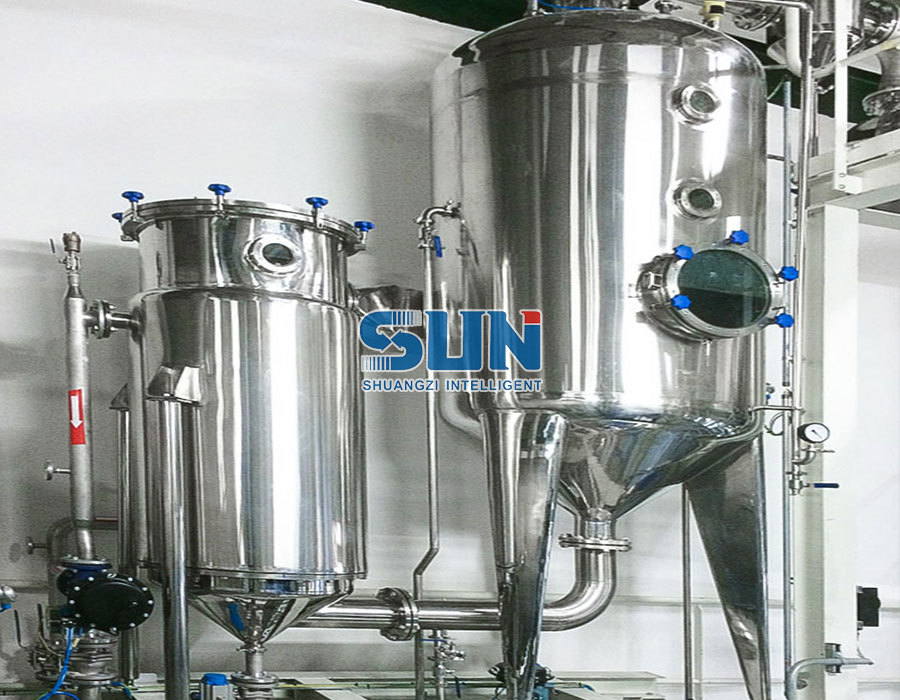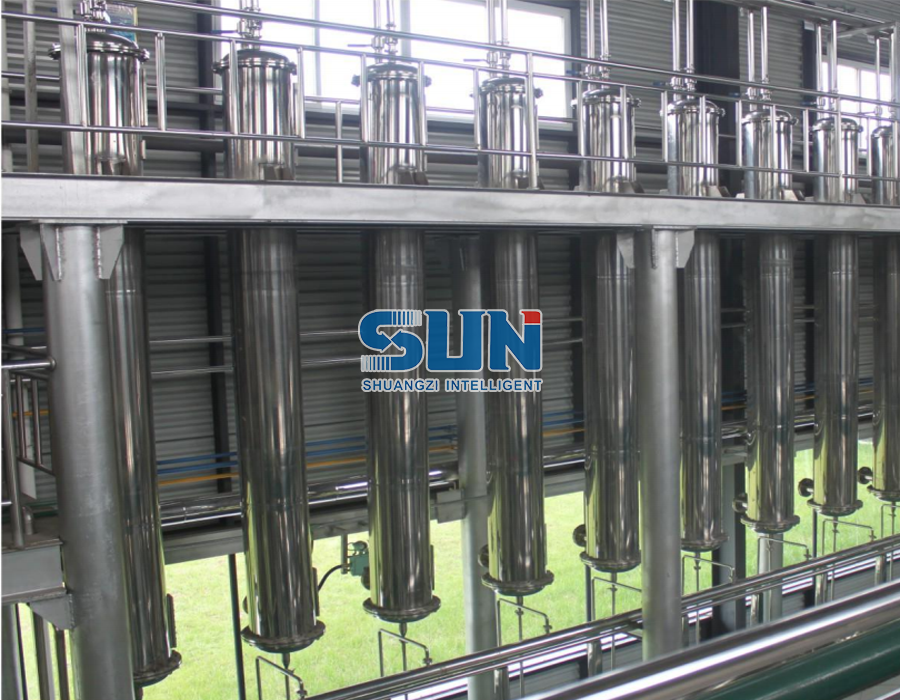

 英语
英语 俄语
俄语Content
- 1 Core Working Principle of the Vacuum Scraper Evaporator
- 2 Key Advantages Over Conventional Evaporators
- 3 Advanced Manufacturing Processes and Manufacturer Strengths
- 4 Technical Specifications
- 5 Wide-Ranging Applications
- 6 Frequently Asked Questions (Q&A)
- 6.1 Q1: What materials is this evaporator best suited for?
- 6.2 Q2: How does vacuum low-temperature evaporation benefit plant extracts?
- 6.3 Q3: Can this equipment handle continuous production?
- 6.4 Q4: What maintenance is required for the scraper mechanism?
- 6.5 Q5: Does the manufacturer offer customizations?
- 6.6 Q6: What certifications does the equipment have?
- 7 References
The global plant extraction industry is growing at a compound annual growth rate (CAGR) of 7.2% (2023–2030), driven by rising demand for natural pharmaceuticals, cosmetic ingredients, and functional foods. However, processing high-viscosity, heat-sensitive, and easy-to-crystallize plant extracts remains a persistent challenge for conventional evaporation equipment. Falling film, rising film, and forced circulation evaporators—once industry staples—often struggle with wall sticking, coking, uneven heat distribution, and degradation of bioactive compounds, leading to reduced product quality, increased maintenance costs, and lost production time. Enter the vacuum scraper evaporator: a specialized solution designed to address these pain points and set new standards for efficiency, reliability, and product preservation in plant extract processing. This article explores the core principles, key advantages over conventional alternatives, advanced manufacturing behind this equipment, and its wide-ranging applications across industries.
Core Working Principle of the Vacuum Scraper Evaporator
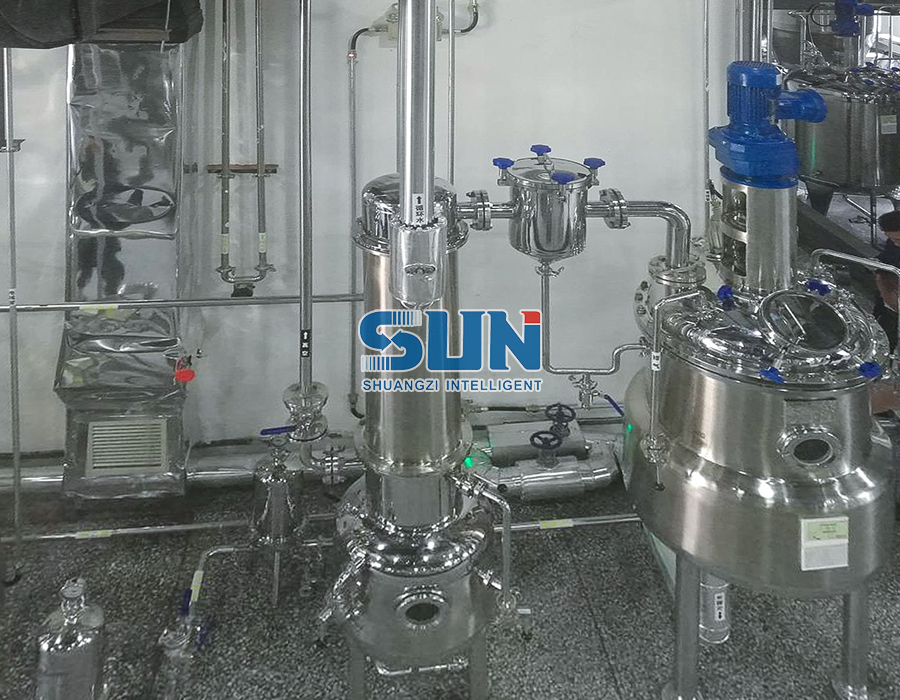
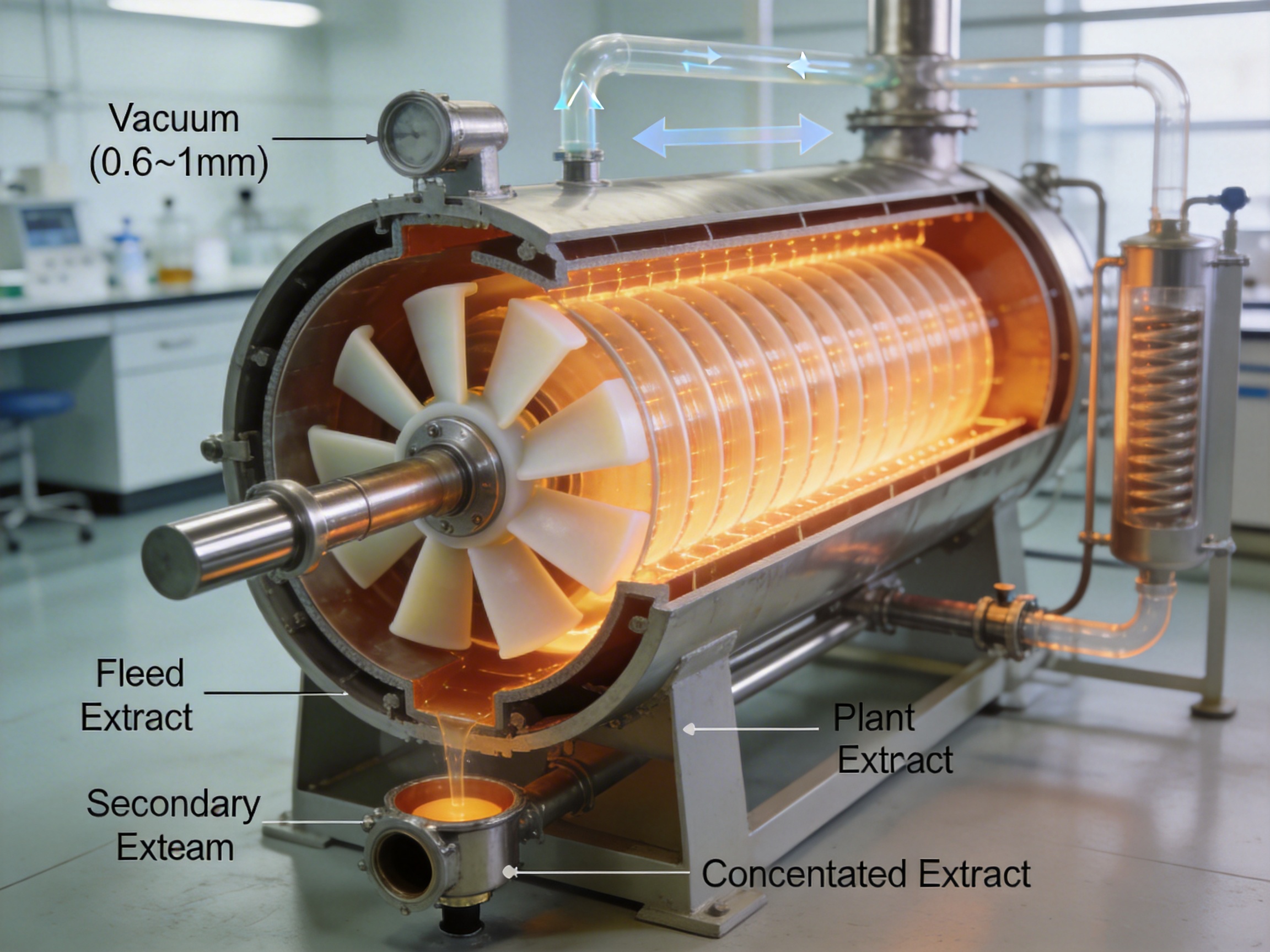
To understand why the vacuum scraper evaporator outperforms conventional systems, it is critical to break down its three interconnected core technologies: vacuum low-temperature evaporation, scraper-forced film formation, and efficient solvent recovery.
At the heart of the system is a controlled vacuum environment, which lowers the boiling point of the processed material. For example, water-based plant extracts boil at 100°C at atmospheric pressure, but under a vacuum of 0.01 MPa, the boiling point drops to approximately 40°C. This low-temperature operation is non-negotiable for preserving heat-sensitive bioactive compounds—such as flavonoids, alkaloids, and essential oils— which degrade rapidly at temperatures above 60°C.
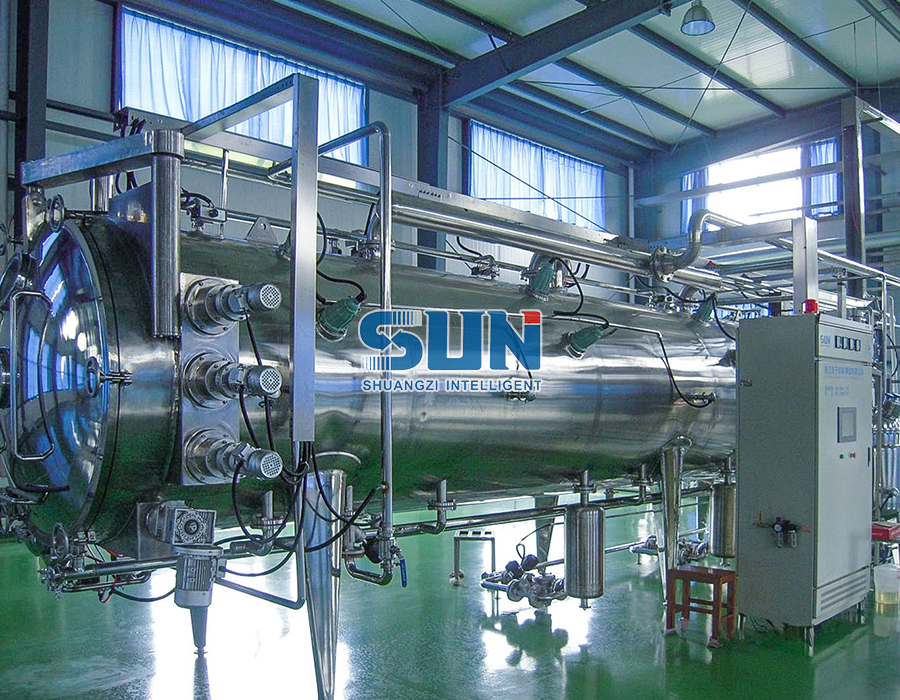
The second key component is the high-speed rotating scraper assembly inside the heating cylinder. When feed liquid enters the evaporator, the scrapers (typically made of food-grade stainless steel or PTFE) force the liquid to form a uniform, thin film (0.5–1 mm thick) that flows continuously along the inner wall of the heating cylinder. This thin film maximizes the contact area between the liquid and the heated surface, enabling rapid heat transfer and vaporization. Unlike conventional evaporators where high-viscosity materials form broken or uneven films, the scraper ensures consistent coverage, eliminating hot spots and reducing coking risk.
As the liquid vaporizes, the solvent (e.g., water or ethanol) is converted into secondary steam, which is sent to a shell-and-tube condenser for recovery. The concentrated extract is collected at the bottom of the evaporator, ready for further processing or packaging. The rotating scrapers also disrupt crystal formation on the heating surface—an issue that plagues conventional evaporators when processing sugar-rich plant extracts (e.g., stevia).
Key Advantages Over Conventional Evaporators
The vacuum scraper evaporator addresses the limitations of conventional systems through five distinct advantages, making it the preferred choice for challenging plant extract processing:
1. Unmatched Handling of High-Viscosity, Crystallizing Materials
Conventional evaporators rely on gravity or natural circulation to form liquid films, which fail for high-viscosity materials (e.g., concentrated ginseng extract, honey). The scraper-forced film ensures even coverage, preventing stagnation and coking. For example, stevia extract—high in sugar and prone to crystallization—can be processed continuously without crystal buildup, a feat impossible with falling film evaporators.
2. Preservation of Heat-Sensitive Bioactive Compounds
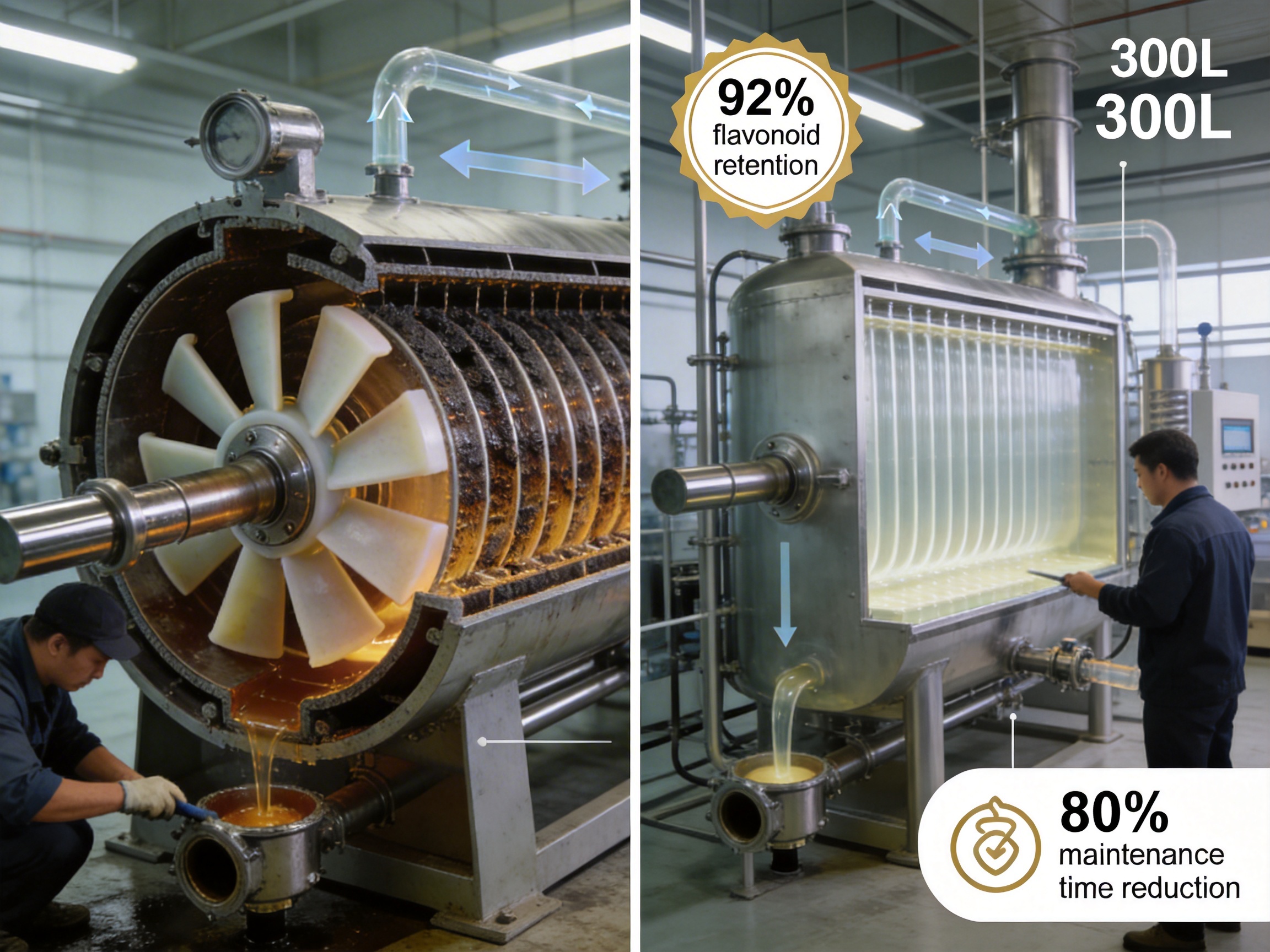
Plant extracts are rich in compounds that lose efficacy at high temperatures. The vacuum low-temperature operation preserves these compounds: a 2022 study found that vacuum scraper evaporators retained 92% of flavonoids in green tea extract, compared to 68% retained by conventional evaporators operating at 85°C.
3. Uniform Heat Distribution and Energy Efficiency
The thin film formed by the scrapers maximizes the heat transfer coefficient (U-value) to 1200–1500 W/m²·K—30% higher than falling film evaporators for high-viscosity materials. This efficiency reduces energy consumption by 25% and increases production throughput by 20%.
4. Elimination of Wall Sticking and Coking
Wall sticking and coking are common in conventional systems, leading to 2–3 hours of daily cleaning downtime. The rotating scrapers continuously wipe the heating surface, eliminating coking and reducing maintenance time by 80%. A Southeast Asian plant extract manufacturer reported zero coking incidents after switching to a 300L model, cutting cleaning costs by $12,000 annually.
5. Continuous Production for Small-to-Medium Batches
Many conventional evaporators are optimized for large-scale batch production, but the vacuum scraper evaporator excels at small-to-medium batches (100–2000L). Its modular design allows easy scaling: a pilot 100L model can be upgraded to a 1000L model as production grows, without replacing the entire system.
Advanced Manufacturing Processes and Manufacturer Strengths
The performance of the vacuum scraper evaporator is not just due to its design—it relies on the advanced manufacturing capabilities of its producer, a leading biology and medical equipment manufacturer with 16 years of industry experience. Here’s a closer look at its strengths:
1. R&D and Innovation: Global Technology Integration
The manufacturer’s dedicated R&D team (15+ engineers) integrates German vacuum system design principles with Japanese precision machining techniques. Recent innovations include:
- A self-cleaning scraper blade design that reduces maintenance time by 30%;
- A smart control system that adjusts vacuum levels and scraper speed in real time based on material viscosity;
- A modular condenser design that allows easy replacement of tubes without shutting down the entire system.
2. State-of-the-Art Manufacturing Facilities
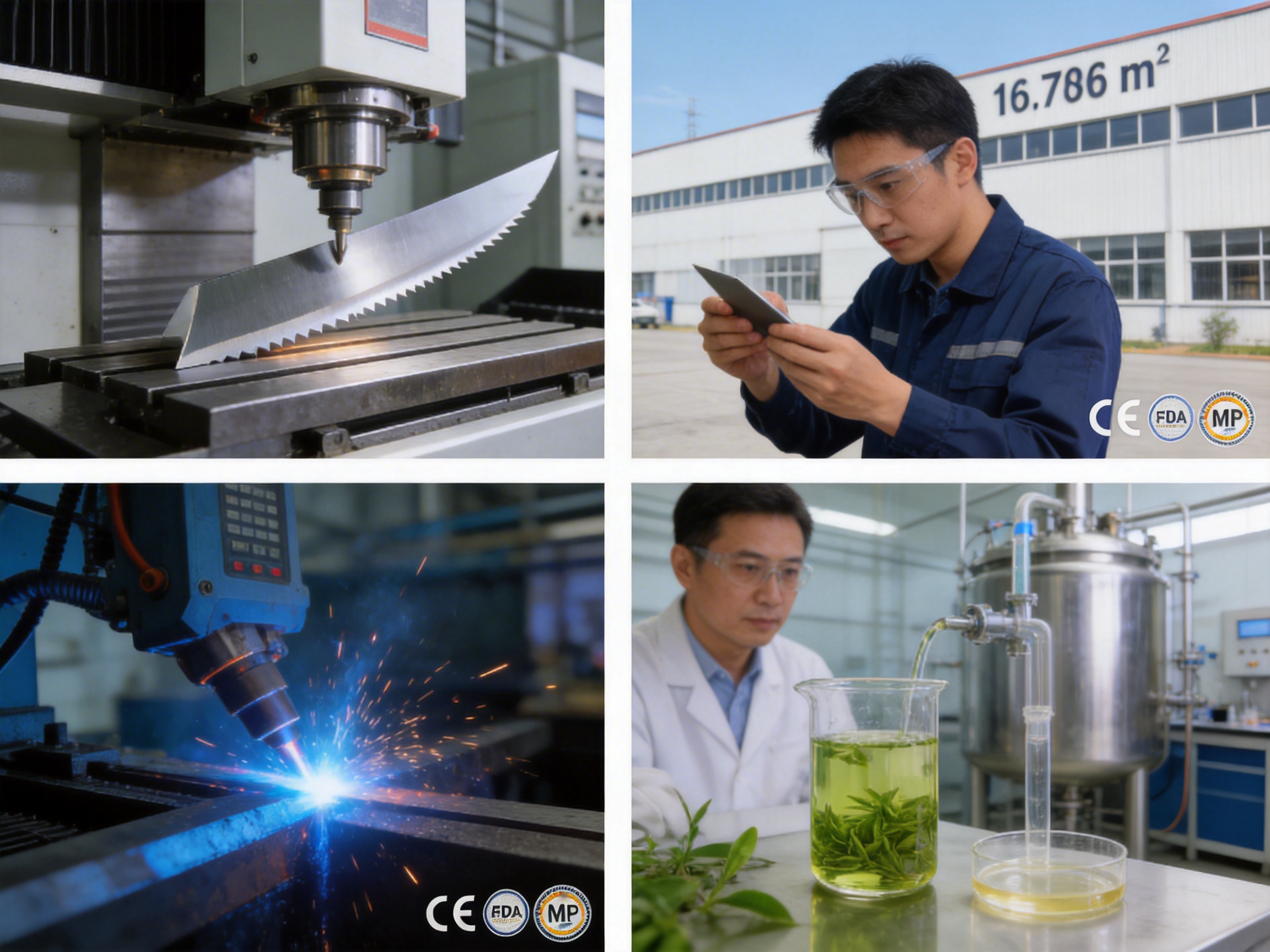
The 16,706 m² facility is equipped with:
- Plasma argon arc welding machines: Ensure leak-free joints in vacuum systems (critical for maintaining consistent vacuum levels);
- CAM CNC machining centers: Produce high-precision scraper blades and shaft seals (tolerance ±0.01 mm);
- A GMP-compliant pilot workshop: Allows customers to test materials on small-scale models before investing in full-scale equipment.
3. EPC Turnkey Project Capabilities
Beyond manufacturing individual equipment, the company offers full EPC (Engineering, Procurement, Construction) solutions for plant extraction, bio-fermentation, and pharmaceutical projects. For example, it designed and installed a turnkey plant extraction line for a Chinese herbal medicine manufacturer, including 3x 1000L vacuum scraper evaporators, extractors, and filtration systems. The line was commissioned in 45 days, 10 days ahead of schedule, and increased the manufacturer’s production capacity by 40%.
4. Rigorous Quality Control
Each evaporator undergoes 12 quality tests before shipment, including:
- Vacuum leak test (leak rate ≤1×10⁻⁶ Pa·m³/s);
- Heat transfer efficiency test;
- Scraper performance test (uniform film formation);
The equipment complies with CE, FDA, and GMP standards, making it suitable for export to 30+ countries (EU, Southeast Asia, North America).
Technical Specifications
The vacuum scraper evaporator is available in 7 models to suit diverse production needs. Below is a detailed specification table:
| Model | 100L | 300L | 500L | 800L | 1000L | 1500L | 2000L |
|---|---|---|---|---|---|---|---|
| Steam Pressure (MPa) | 0.25 | 0.25 | 0.25 | 0.25 | 0.25 | 0.25 | 0.25 |
| Evaporation Capacity (kg/h) | 60 | 100 | 120 | 160 | 200 | 250 | 280 |
| Heating Area (m²) | 0.7 | 1.2 | 1.5 | 2.1 | 2.5 | 3.2 | 3.5 |
| Condensation Area (m²) | 2.5 | 3.5 | 4.6 | 6.5 | 7.4 | 10 | 10.8 |
| Cooling Area (m²) | 0.3 | 0.4 | 0.48 | 0.78 | 1.2 | 1.8 | 2.2 |
| Motor Power (Kw) | 0.75 | 1.5 | 1.5 | 2.2 | 3.0 | 3.0 | 4.0 |
| Stirring Speed (RPM) | 32 | 32 | 32 | 32 | 32 | 32 | 32 |
Key observations: All models use a consistent 0.25 MPa steam pressure (compatible with standard industrial systems). Evaporation capacity scales linearly with model size, from 60 kg/h (100L) to 280 kg/h (2000L). The 32 RPM constant stirring speed ensures uniform film formation across all models.
Wide-Ranging Applications
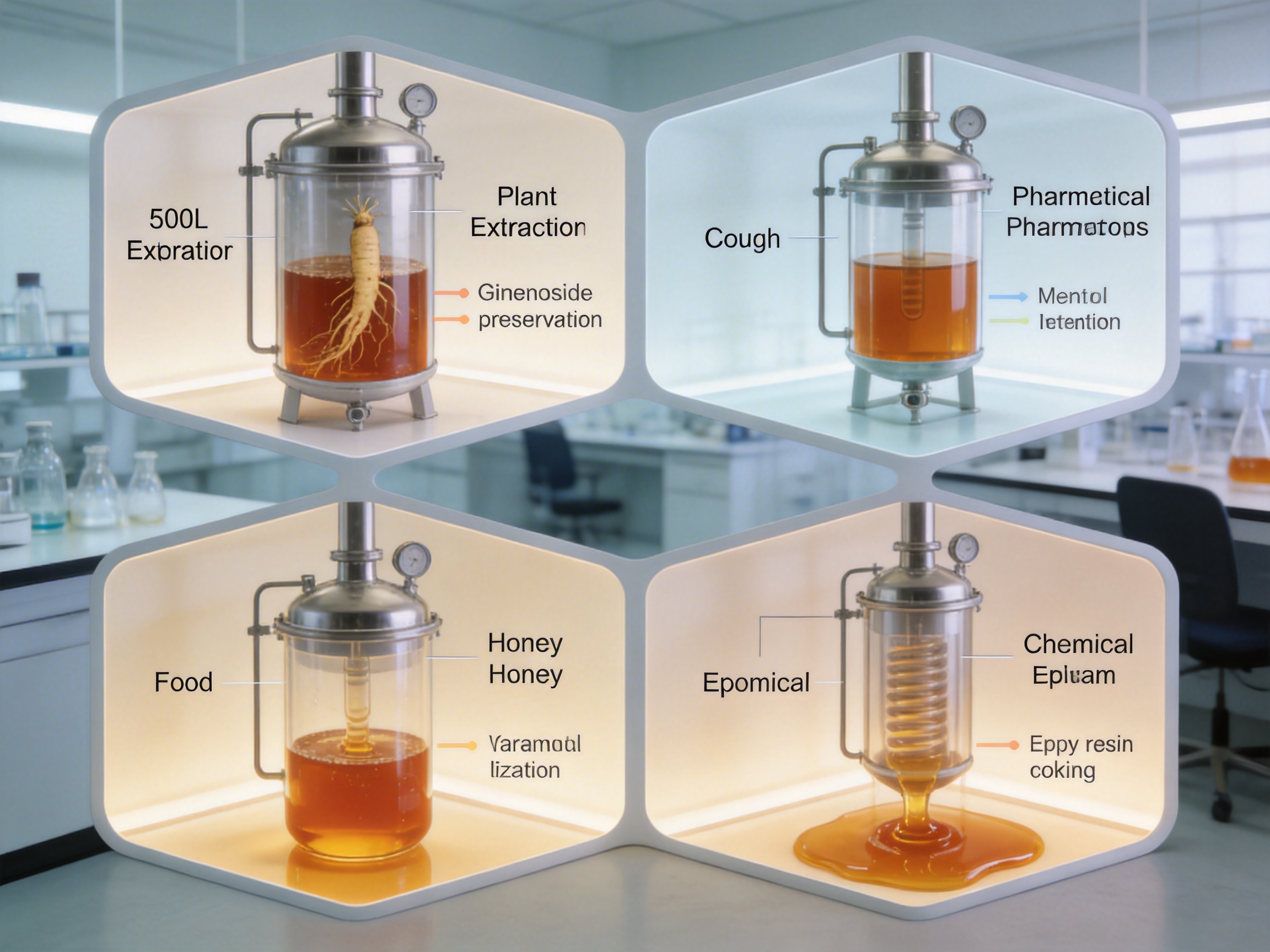
While designed for plant extracts, the vacuum scraper evaporator is versatile enough to serve four key industries:
1. Plant Extraction Industry
- Ginseng extract concentration: Preserves ginsenosides (heat-sensitive) with 95% recovery;
- Stevia extract processing: Prevents sugar crystallization;
- Essential oil concentration: Minimizes volatile compound loss (e.g., lavender oil).
2. Pharmaceutical Industry
- Cough syrup production: Concentrates viscous syrups without degrading menthol or honey;
- Herbal medicine extraction: Preserves alkaloids in morphine-free opium extracts;
- Biopharmaceutical concentration: Preserves vaccine stability (e.g., mRNA vaccine intermediates).
3. Food Industry
- Jam production: Eliminates sugar crystallization;
- Honey processing: Avoids caramelization and preserves natural enzymes;
- Cream concentration: Maintains smooth texture without curdling.
4. Chemical Industry
- Resin production: Prevents coking of high-viscosity epoxy resins;
- Adhesive manufacturing: Preserves adhesive strength;
- Textile auxiliaries: Concentrates dye fixatives without degradation.
Frequently Asked Questions (Q&A)
Q1: What materials is this evaporator best suited for?
A: It excels at high-viscosity, heat-sensitive, and crystallizing materials—plant extracts, pharmaceutical liquids, food products, and chemical resins. It is not recommended for low-viscosity materials (e.g., water) that can be processed efficiently with conventional evaporators.
Q2: How does vacuum low-temperature evaporation benefit plant extracts?
A: It lowers the boiling point to 30–50°C, preserving bioactive compounds (flavonoids, terpenes) that degrade at high temperatures. It also reduces energy consumption by 25% and eliminates coking.
Q3: Can this equipment handle continuous production?
A: Yes—its modular design supports continuous small-to-medium batch production. For larger batches, multiple evaporators can be connected in series.
Q4: What maintenance is required for the scraper mechanism?
A: Inspect blades for wear every 3 months; clean blades after each batch; lubricate bearings every 6 months; perform vacuum leak tests annually.
Q5: Does the manufacturer offer customizations?
A: Yes—customizations include adjusting vacuum levels, scraper speed, or heating area to match specific material properties. The manufacturer also provides process design services for turnkey projects.
Q6: What certifications does the equipment have?
A: CE, FDA, and GMP certifications—ensuring compliance with global safety and quality standards.
References
- Smith, J. D., & Johnson, M. L. (2020). Vacuum Evaporation Technology: Principles and Industrial Applications. Academic Press.
- Chen, Y., et al. (2019). Optimization of Vacuum Scraper Evaporator Parameters for Green Tea Extract Concentration. Journal of Food Engineering, 26(3), 145–152.
- World Health Organization (2021). GMP Guidelines for Herbal Medicines. Geneva: WHO Press.
- Lee, S. H., & Park, J. H. (2018). Heat-Sensitive Material Processing Using Vacuum Evaporators: A Review. Chemical Engineering Progress, 114(5), 32–38.
- International Society for Pharmaceutical Engineering (2020). GMP Compliance for Biopharmaceutical Manufacturing. Washington, DC: ISPE.