
 英语
英语 俄语
俄语Content
- 1 1. Product Overview
- 2 2. Core Structure and Functional Components
- 3 3. Operating Principle
- 4 4. Advantages Over Conventional Evaporation Equipment
- 5 5. Comparison with Alternative Concentration Methods
- 6 6. Application in Plant Extraction Projects
- 7 7. Application in Pharmaceutical and Health Food Production
- 8 8. Application in Food, Juice, and Natural Flavor Processing
- 9 9. Application in Fine Chemical and Solvent-Based Processing
- 10 10. Manufacturing Strengths Behind the Equipment
- 11 11. Precision Stainless-Steel Fabrication
- 12 12. Engineering and System Integration Capability
- 13 13. Pilot Production and Research Support
- 14 14. Automation and Process Control Considerations
- 15 15. Product Quality Advantages for Users
- 16 16. Practical Selection Considerations
- 17 17. Cleaning, Maintenance, and Long-Term Reliability
- 18 18. Safety Considerations
- 19 19. Why the Spherical Design Matters
- 20 20. Role in Turnkey Processing Projects
- 21 21. Competitive Advantages in the Market
- 22 22. Frequently Asked Questions
- 22.1 Q1. What is the main purpose of a spherical vacuum evaporator?
- 22.2 Q2. Why is vacuum operation important?
- 22.3 Q3. What are the main components of the equipment?
- 22.4 Q4. What materials is it suitable for?
- 22.5 Q5. How does the spherical structure help prevent coking?
- 22.6 Q6. Can it recover ethanol?
- 22.7 Q7. Is the evaporator suitable for large continuous production?
- 22.8 Q8. What are its advantages compared with an open boiling kettle?
- 22.9 Q9. What manufacturing strengths support product reliability?
- 22.10 Q10. What information should users provide before selecting a model?
- 23 23. Conclusion
- 24 References
- 25 Product: Spherical Vacuum Evaporator
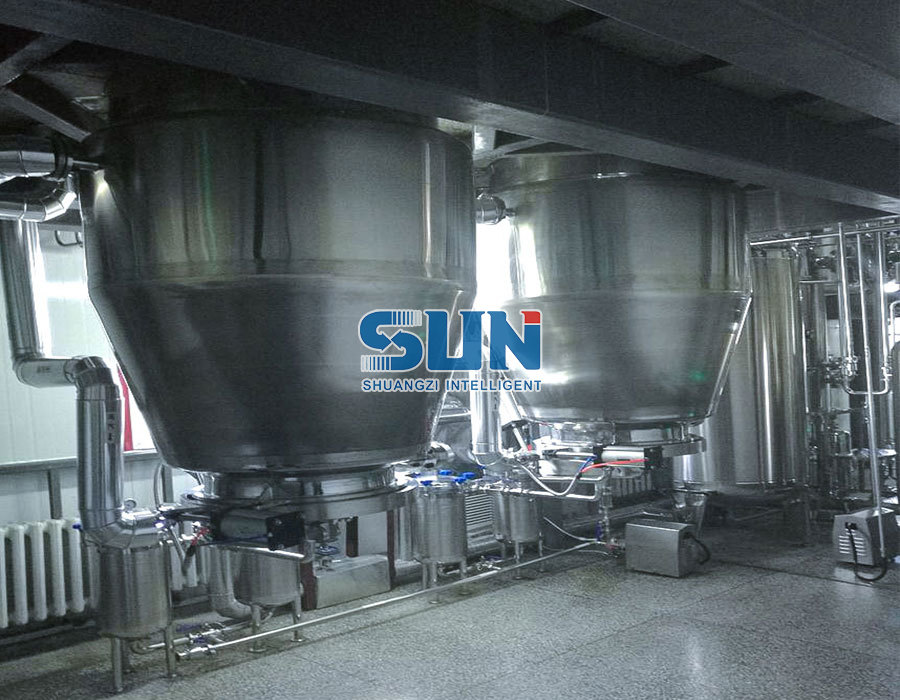
In modern pharmaceutical, botanical extraction, food, flavor, and fine chemical processing, concentration is more than a simple reduction of liquid volume. It is a controlled operation that must protect heat-sensitive ingredients, preserve aroma and flavor, recover valuable solvents, reduce energy use, and maintain repeatable batch quality. The spherical vacuum evaporator is designed for exactly this role. Built around a stainless-steel spherical main tank and supported by a condenser, gas-liquid separator, and liquid receiving tank, it offers a practical and reliable solution for vacuum concentration and organic solvent recovery in medium and small-scale production.
This article focuses on the spherical vacuum evaporator, its working principles, structural advantages, practical applications, and the manufacturing strengths behind its production. The equipment is especially suitable for the concentration of traditional herbal extracts, botanical extracts, fruit juice, health food ingredients, natural flavors, and solvent-containing process liquids. Because it operates under vacuum and at relatively low temperature, it helps retain original material characteristics while reducing the risk of thermal degradation, wall adhesion, and coking.
Compared with many conventional open boiling kettles, standard jacketed tanks, and less optimized evaporator designs, the spherical vacuum evaporator provides a more balanced combination of heat transfer, material circulation, solvent recovery, ease of cleaning, and batch flexibility. Its compact layout makes it accessible for manufacturers that require dependable concentration performance without the complexity or footprint of large continuous evaporation systems. For companies working with valuable plant extracts, active ingredients, alcohol-based extraction liquids, or aroma-sensitive liquids, this type of evaporator can be a core piece of process equipment.
1. Product Overview
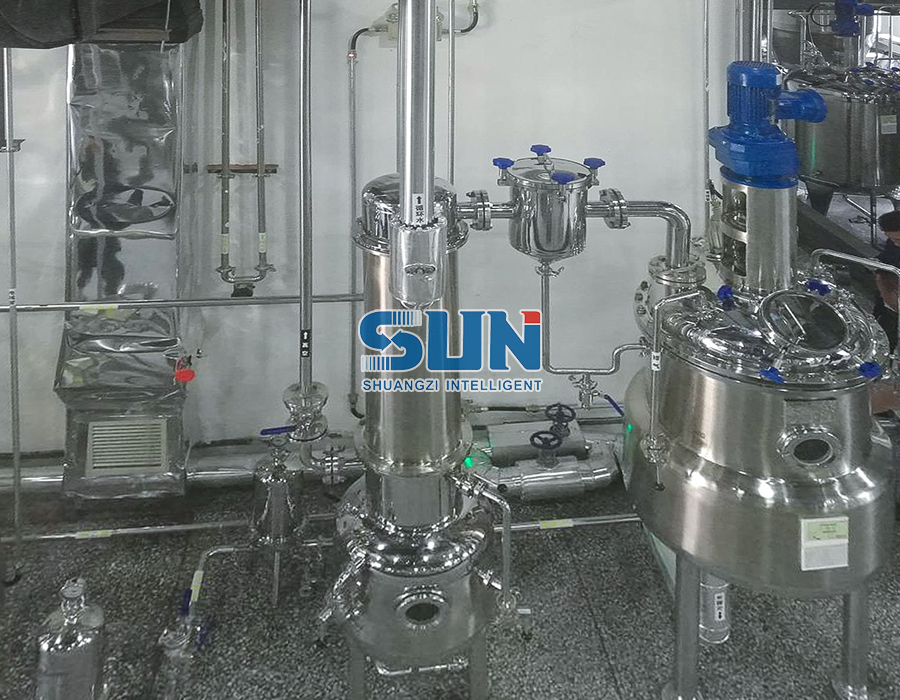
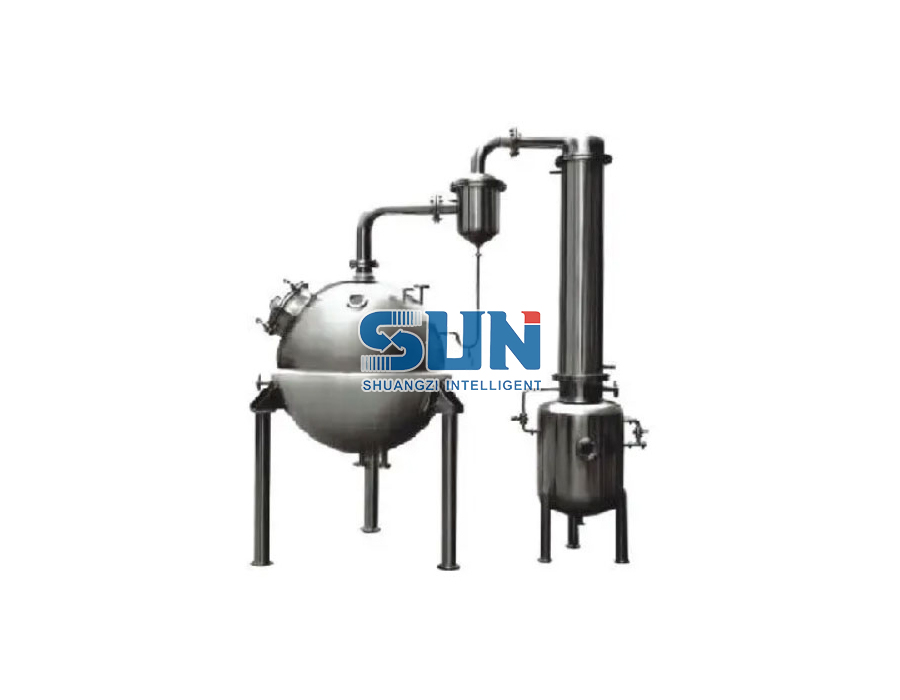
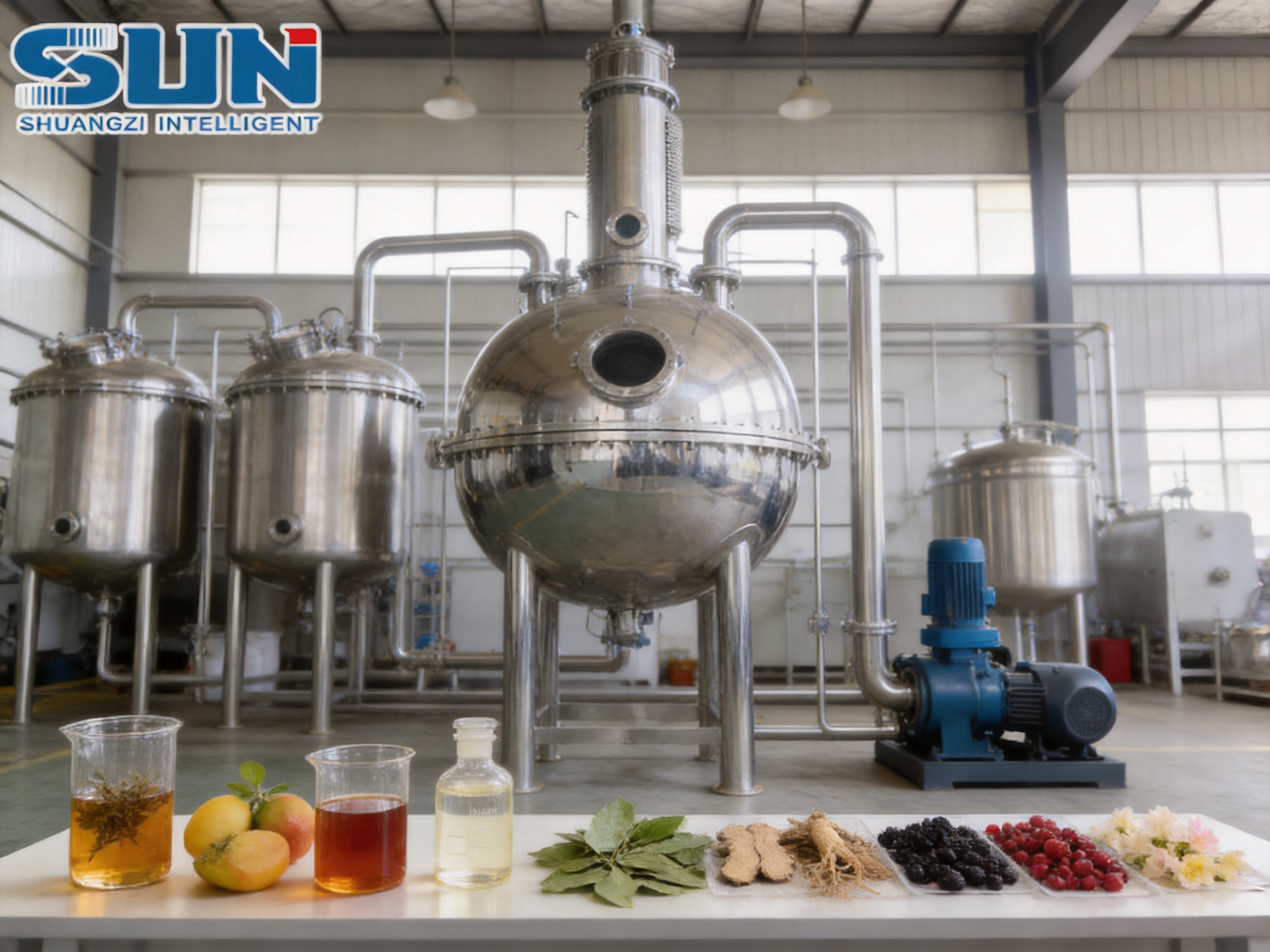
The spherical vacuum evaporator is constructed primarily from 304 stainless steel and consists of four essential assemblies: the spherical main tank, condenser, gas-liquid separator, and liquid receiving tank. Steam is introduced into the jacket surrounding the vessel, providing heat to the material inside. At the same time, the system operates under vacuum, lowering the boiling point of the liquid. As a result, evaporation occurs at a lower temperature than atmospheric boiling, which is particularly important for materials that may lose potency, aroma, color, or nutritional value when exposed to high heat.
The spherical shape is central to the product’s value. A spherical inner shell provides a large heating area relative to volume, improves natural circulation of liquid, and reduces dead zones. This helps the liquid heat more evenly and minimizes the likelihood of materials sticking to the wall or forming burnt deposits. In industries where extracts may contain sugars, gums, proteins, resins, pigments, or other viscous components, this design can significantly improve processing reliability.
The equipment is designed for batch operation. Operators can feed material into the tank, apply vacuum, heat through the jacket, condense evaporated vapor, separate entrained droplets, collect recovered liquid, and discharge the concentrated product. This makes the equipment highly suitable for production lines that handle multiple formulas, changing batch sizes, or different solvent systems. It is also useful in pilot production, product development, and specialized manufacturing where flexibility matters as much as throughput.
For solvent recovery, the evaporated solvent vapor passes through the condenser and is converted back into liquid. The receiving tank collects the recovered solvent, allowing users to reuse ethanol or other organic solvents where permitted by process requirements. This reduces raw material costs, decreases solvent waste, and supports safer and more sustainable production practices.
2. Core Structure and Functional Components
2.1 Spherical Main Tank
The spherical main tank is the heart of the evaporator. It receives the process liquid and provides the main evaporation chamber. The spherical geometry allows heat to be distributed across a curved surface, encouraging smoother liquid movement. Unlike flat-bottomed or poorly shaped vessels that may develop stagnant zones, the spherical vessel supports more balanced internal circulation. This contributes to stable concentration performance, especially when processing materials with changing viscosity during evaporation.
The tank is commonly made of 304 stainless steel, which offers good corrosion resistance, cleanability, mechanical strength, and suitability for many pharmaceutical, food, botanical, and chemical applications. For producers working with aqueous extracts, ethanol extracts, fruit juice, natural flavor liquids, and many moderate organic solvents, 304 stainless steel provides a dependable material foundation. The smooth internal surface also helps reduce residue retention and simplifies cleaning after each batch.
2.2 Steam Jacket
The steam jacket supplies heat to the process liquid. Steam enters the jacket and transfers heat through the stainless-steel wall into the material. Because the vessel operates under vacuum, the required process temperature is reduced. This means that the heat input can support evaporation without exposing sensitive materials to unnecessarily high temperatures.
Jacketed heating is robust, simple to operate, and easy to maintain. It avoids the need for direct steam injection, which may dilute the product or introduce contamination risks. The indirect heating method also supports cleaner processing and more controlled concentration.
2.3 Condenser
The condenser receives vapor generated from the evaporation chamber. Cooling water or another cooling medium removes heat from the vapor, causing it to condense into liquid. In solvent recovery applications, this function is critical because it allows alcohol or other volatile solvents to be collected rather than lost to the atmosphere.
An efficient condenser improves recovery rate, reduces solvent emissions, supports environmental compliance, and contributes to lower operating cost. It also helps maintain stable vacuum by continuously removing vapor from the system.
2.4 Gas-Liquid Separator
The gas-liquid separator helps remove entrained droplets from the vapor stream. During evaporation, especially when materials foam or boil vigorously, tiny liquid droplets can be carried upward with the vapor. If not separated, these droplets may contaminate the recovered solvent, reduce product yield, and increase downstream cleaning requirements.
By separating liquid from gas or vapor, the equipment improves recovery quality and protects the condenser and receiving tank from unnecessary contamination. This is especially valuable in botanical extraction and traditional herbal processing, where liquids can foam due to saponins, polysaccharides, proteins, or natural surfactants.
2.5 Liquid Receiving Tank
The receiving tank collects condensed solvent or water vapor. It is an important part of the recovery system and allows operators to measure, transfer, or reuse the recovered liquid. In ethanol recovery processes, the receiving tank helps capture valuable solvent that can be returned to extraction or cleaning operations depending on purity and process control standards.
The receiving tank also supports safer operation by containing recovered liquid in a controlled stainless-steel vessel rather than allowing vapor discharge into the workshop environment.
3. Operating Principle
The spherical vacuum evaporator operates by combining indirect heating with vacuum evaporation. First, process liquid is introduced into the spherical tank. The vacuum system reduces internal pressure, lowering the boiling point of the liquid. Steam is then supplied to the jacket, transferring heat into the material. Because of the reduced pressure, evaporation begins at a lower temperature than normal atmospheric boiling.
As vapor forms, it rises from the liquid surface and passes through the gas-liquid separation section. Entrained droplets are separated and returned or retained, while vapor continues to the condenser. In the condenser, the vapor loses heat and becomes liquid. The condensed liquid is collected in the receiving tank. The concentrated product remains in the spherical tank until the target concentration is reached.
This process allows concentration and solvent recovery to occur simultaneously. For example, an ethanol botanical extract can be concentrated in the main tank while ethanol vapor is condensed and collected. This reduces solvent consumption and decreases production costs. For fruit juice or flavor liquids, low-temperature operation helps protect natural sensory properties. For pharmaceutical or health food materials, it helps reduce thermal damage to active components.
The equipment is especially useful when the product is processed batch by batch and when the operator needs direct control over concentration time, vacuum level, heating intensity, and final product consistency.
4. Advantages Over Conventional Evaporation Equipment
4.1 Better Protection of Heat-Sensitive Materials
Many active ingredients, aroma compounds, pigments, vitamins, and plant-derived compounds are sensitive to heat. Traditional atmospheric boiling can expose materials to high temperatures for extended periods, causing degradation, color darkening, flavor loss, or reduction in biological activity. The spherical vacuum evaporator reduces the boiling point of the liquid by operating under vacuum, allowing evaporation at lower temperature.
This feature is especially important for traditional herbal extracts, botanical extracts, natural flavors, fruit juice concentrates, and health food ingredients. By reducing heat stress, the equipment helps preserve original flavor, active ingredients, and product quality.
4.2 Reduced Wall Adhesion and Coking
Wall adhesion and coking are common problems in concentration equipment. As water or solvent evaporates, the remaining liquid becomes thicker. Sugars, proteins, herbal solids, resins, and other components can adhere to hot surfaces. If the material remains on the wall too long, it may overheat and form burnt deposits. This reduces yield, affects product quality, increases cleaning time, and may contaminate future batches.
The spherical inner shell helps liquid circulate evenly and reduces the formation of stagnant zones. The large heating area distributes heat more gently. As a result, the risk of localized overheating is lower than in poorly designed vessels. This is one of the most important practical advantages of the spherical vacuum evaporator.
4.3 Compact and Practical Batch Design
Large multi-effect evaporators and continuous systems are powerful, but they are not always suitable for every manufacturer. They may require high investment, large installation space, complex controls, and stable high-volume feed. The spherical vacuum evaporator offers a compact and accessible batch solution for medium and small-scale production. It is ideal for companies that produce multiple products, run pilot batches, or require flexible scheduling.
The compact structure also makes cleaning, maintenance, inspection, and installation easier. For facilities that need dependable concentration without excessive system complexity, this type of evaporator is a practical choice.
4.4 Solvent Recovery and Cost Reduction
Solvents such as ethanol are widely used in botanical extraction, pharmaceutical extraction, natural flavor extraction, and fine chemical processing. Solvent cost can be significant, especially when production is frequent. By recovering ethanol and other organic solvents through condensation, the spherical vacuum evaporator helps reduce purchasing costs and waste disposal costs.
Solvent recovery also contributes to safer and more environmentally responsible production. Less vapor is released, less solvent is wasted, and the production workshop can maintain better process control.
4.5 Easy Cleaning and Maintenance
The equipment is designed with a relatively simple structure, smooth stainless-steel surfaces, and accessible components. Cleaning and maintenance are important in pharmaceutical, food, and natural product industries because product residues can affect hygiene, flavor, batch consistency, and regulatory compliance. A system that is easier to clean can reduce downtime and labor cost.
Compared with complicated evaporators with many internal passages, narrow tubes, or difficult-to-access areas, the spherical vacuum evaporator is more straightforward. This makes it a strong option for facilities handling multiple materials or requiring frequent batch changeover.
4.6 Lower Energy Consumption in Appropriate Applications
Energy consumption depends on process conditions, batch size, solvent type, vacuum level, and heating method. However, the spherical vacuum evaporator is designed to support efficient heat transfer through a large heating surface and reduced boiling temperature under vacuum. The compact design also limits unnecessary heat losses. For medium and small-scale operations, these features can help reduce energy consumption compared with less optimized equipment.
5. Comparison with Alternative Concentration Methods
Different concentration technologies have different advantages. Falling film evaporators are excellent for large-volume continuous processing of low-viscosity liquids. Forced circulation evaporators handle scaling and crystallizing solutions well. Open kettles are inexpensive but expose products to high temperature and vapor loss. Rotary evaporators are useful for laboratory scale but not ideal for production batches. The spherical vacuum evaporator occupies an important position between small laboratory devices and large continuous systems.
| Criterion | Spherical Vacuum Evaporator | Open Boiling Kettle | Large Continuous Evaporator | Laboratory Rotary Evaporator |
|---|---|---|---|---|
| Temperature Control | Low-temperature operation under vacuum protects sensitive materials | Higher boiling temperature may damage quality | Good control but often designed for high-volume continuous feed | Good control but limited capacity |
| Solvent Recovery | Integrated condenser and receiving tank support recovery | Usually poor unless additional recovery equipment is installed | Strong recovery but higher investment and complexity | Good for laboratory solvent recovery |
| Batch Flexibility | Strong flexibility for varied formulas and medium or small batches | Flexible but less controlled | Best for stable continuous production | High flexibility but small volume |
| Wall Adhesion Control | Spherical shell supports even circulation and reduces coking risk | Higher risk of sticking and burning | Depends on design and material viscosity | Good for small samples but not production scale |
| Cleaning and Maintenance | Compact and relatively easy to clean | Simple but may require heavy manual cleaning after burning | More complex cleaning due to tubes, pumps, and piping | Easy but limited industrial relevance |
| Typical Use | Botanical extracts, herbal extracts, fruit juice, health food, flavors, fine chemicals | Basic heating and reduction where quality requirements are low | Large-scale continuous concentration | Research and small laboratory recovery |
This comparison shows that the spherical vacuum evaporator is not intended to replace every evaporation technology. Instead, it is optimized for a specific but very common industrial need: controlled batch concentration and solvent recovery for valuable, heat-sensitive, and often viscous process liquids.
6. Application in Plant Extraction Projects
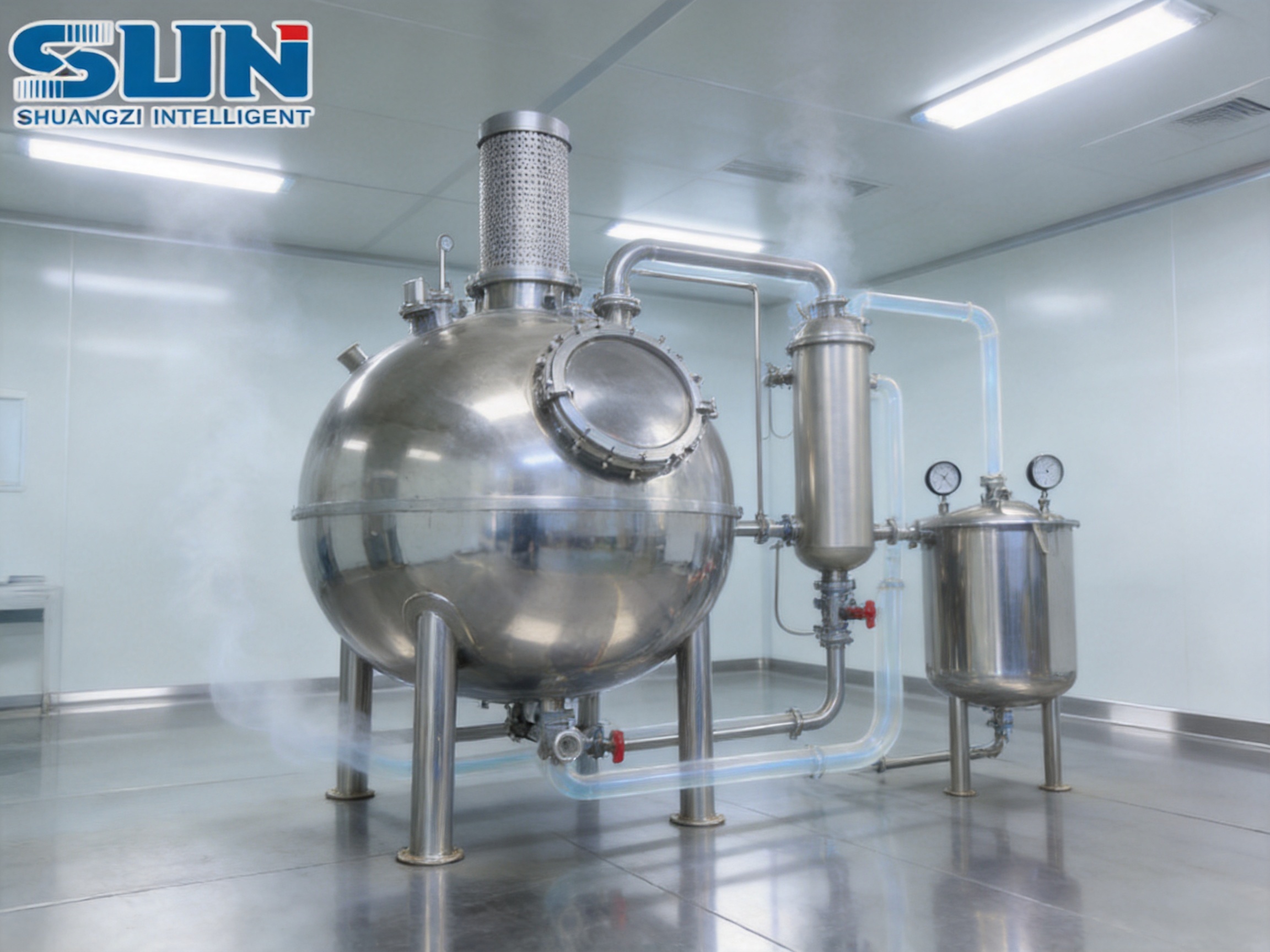
Plant extraction is one of the most important application fields for the spherical vacuum evaporator. Botanical raw materials often contain a complex mixture of active substances, pigments, sugars, fibers, gums, volatile compounds, and solvent-soluble components. After extraction, the liquid extract usually contains large amounts of water, ethanol, or other solvents. Concentration is necessary to prepare a dense extract, reduce storage volume, improve downstream drying efficiency, or prepare final liquid products.
The spherical vacuum evaporator supports this process by concentrating the extract while recovering solvent. For ethanol extraction, the recovered ethanol can reduce overall solvent consumption. For water-based extracts, the lower evaporation temperature helps preserve active ingredients and original sensory properties. Because the spherical tank reduces localized overheating, the risk of burnt herbal notes or darkened extract is minimized.
Plant extract manufacturers often work with many raw materials, such as leaves, roots, fruits, seeds, flowers, and fungi. Each material has different behavior during concentration. Some foam easily; some become sticky; some contain heat-sensitive compounds; some require careful aroma retention. A batch-type spherical vacuum evaporator gives the operator flexibility to adjust process parameters according to each material.
7. Application in Pharmaceutical and Health Food Production
In pharmaceutical and health food production, product consistency, hygiene, ingredient retention, and process repeatability are critical. The spherical vacuum evaporator is suitable for concentrating liquid extracts, intermediate solutions, and solvent-based preparations where controlled low-temperature evaporation is required. It can be used in traditional herbal medicine processing, natural active ingredient production, nutraceutical extracts, and health food concentrates.
The stainless-steel construction supports hygienic processing and cleaning. The closed vacuum system helps reduce exposure to air and contamination. The condenser and receiving tank support solvent recovery, which is especially useful for ethanol-based extraction processes used in pharmaceutical and health food manufacturing.
Because many health food ingredients are valued for their natural flavor, aroma, color, or bioactive content, gentle concentration is an important quality factor. High-temperature boiling can degrade product characteristics, while vacuum evaporation provides a more protective processing environment.
8. Application in Food, Juice, and Natural Flavor Processing
Food and natural flavor producers often need to remove water or solvent while preserving aroma and freshness. Fruit juice, plant-based flavor extracts, natural aroma liquids, and food ingredient concentrates may suffer flavor loss when processed at high temperature. The spherical vacuum evaporator helps reduce this problem by enabling evaporation under low-temperature negative pressure.
For fruit juice concentration, the equipment can help retain original flavor and reduce cooked notes. For natural flavor extraction, it can recover volatile solvent while helping preserve aromatic character. For food ingredient processing, the compact and cleanable stainless-steel design supports practical batch operation.
Although large-scale juice factories may use continuous evaporators, smaller producers and specialty manufacturers often need flexible batch concentration equipment. The spherical vacuum evaporator is well suited to this production model because it can handle varied materials and batch sizes without requiring a massive continuous line.
9. Application in Fine Chemical and Solvent-Based Processing
Fine chemical processing often involves liquid concentration, solvent removal, and recovery of organic solvents. The spherical vacuum evaporator is suitable for compatible chemical systems where low-temperature evaporation, batch flexibility, and solvent recovery are required. Its stainless-steel structure, condenser, separator, and receiving tank create an integrated solution for many solvent removal tasks.
For solvent recovery applications, reducing solvent loss is both an economic and environmental benefit. Solvent recovery can lower material costs, reduce emissions, and decrease waste treatment requirements. The closed configuration is also more controlled than open evaporation.
When selecting the equipment for fine chemical use, compatibility of the solvent and material with 304 stainless steel, gasket materials, seals, and operating conditions should be confirmed. Process safety, flammability control, grounding, ventilation, and explosion protection requirements should also be evaluated according to the solvent being processed.
10. Manufacturing Strengths Behind the Equipment
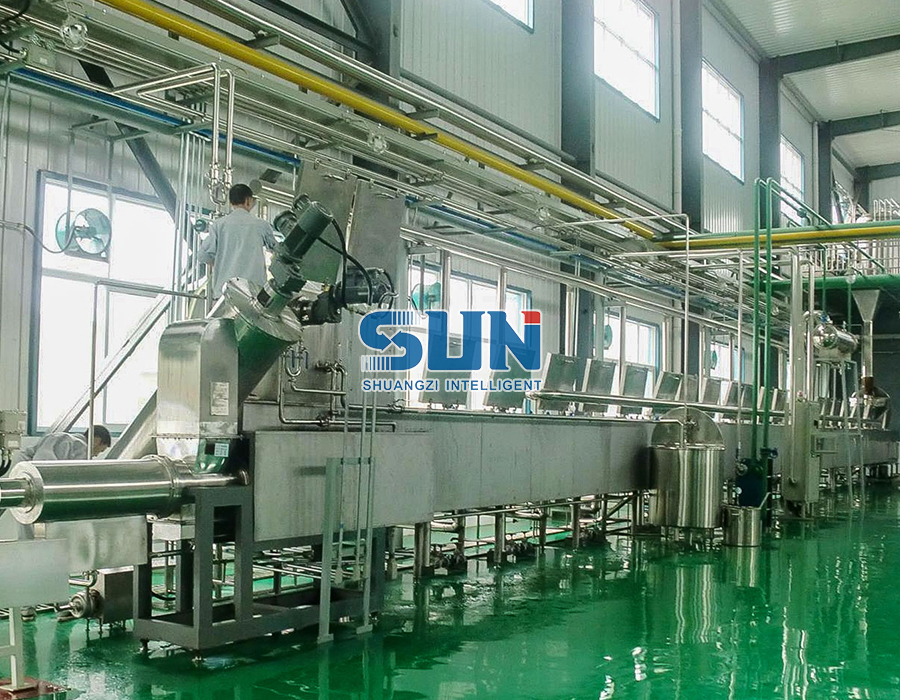
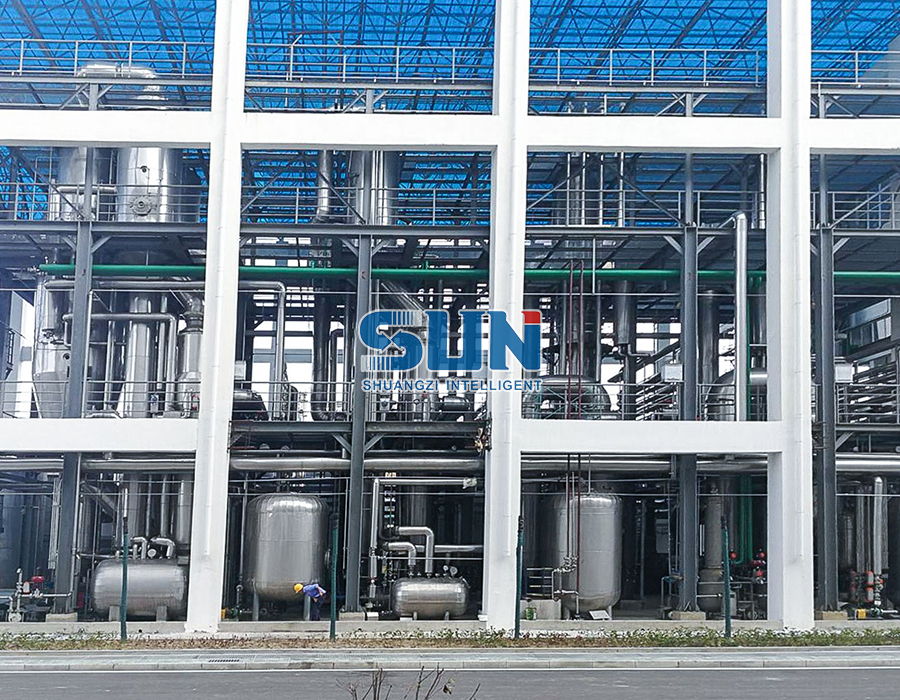
The performance of a spherical vacuum evaporator depends not only on its design but also on manufacturing quality. Zhejiang Shuangzi Intelligent Equipment Co., Ltd. is an equipment enterprise focused on process technology, automation engineering design, equipment manufacture, matching purchase, installation, equipment system integration, and turnkey project services. Its experience covers plant extraction, biological fermentation, pharmaceutical engineering, natural food processing, energy conservation, and environmental protection.
The company’s manufacturing capabilities support the production of evaporation and concentration equipment, extraction systems, fermentation systems, filtration equipment, separation equipment, crystallization equipment, containers, and vacuum low-temperature drying systems. This broad process background is important because a spherical vacuum evaporator often operates as part of a complete production line rather than as an isolated machine.
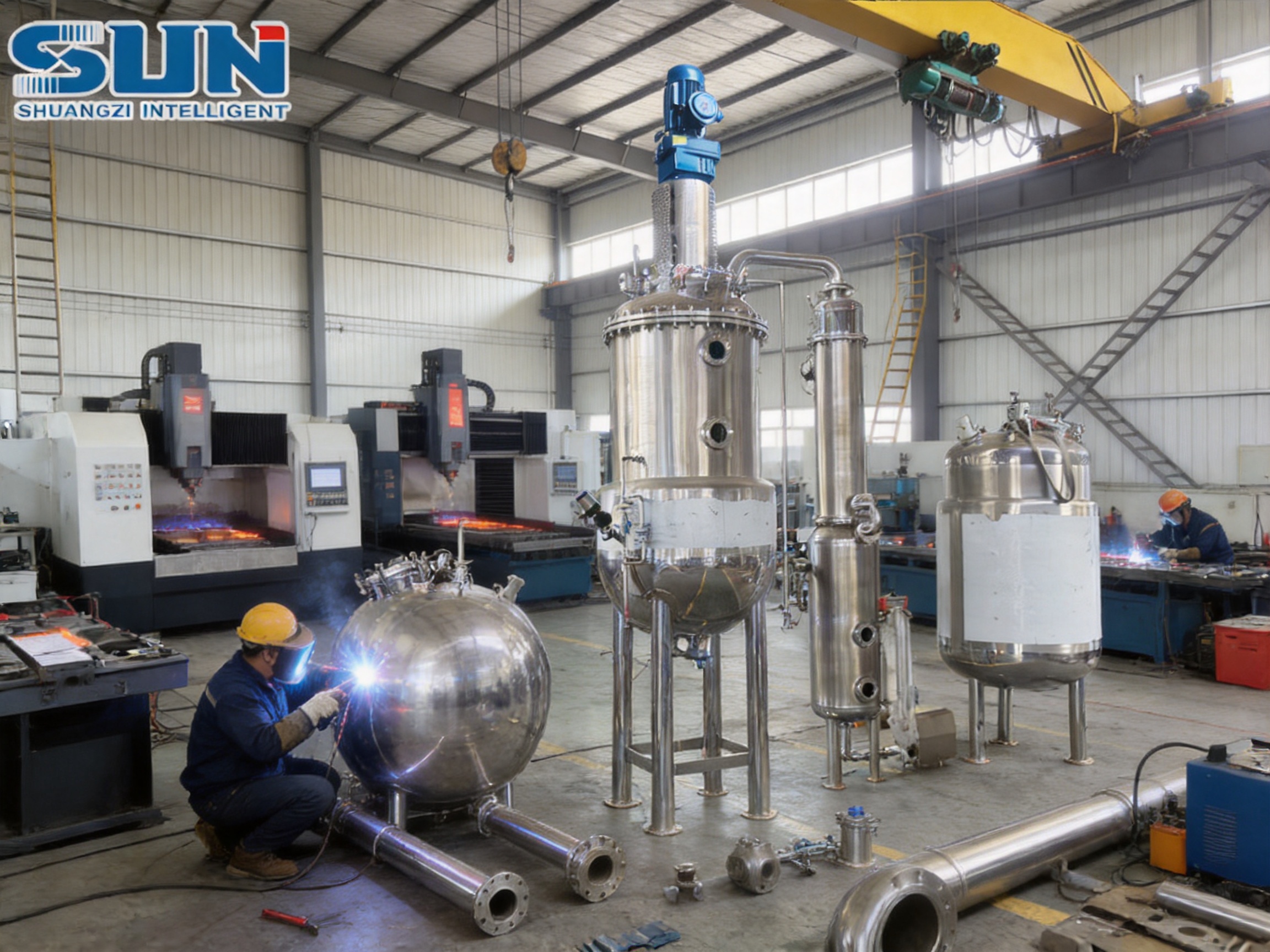
Advanced manufacturing is reflected in several areas. Precision cutting and forming help ensure accurate vessel geometry. High-quality welding is essential for pressure and vacuum performance, hygiene, and long-term reliability. Surface finishing supports cleanability and reduces residue adhesion. Assembly quality affects condenser efficiency, sealing performance, and vacuum stability. Process integration knowledge ensures that the evaporator can connect properly with upstream extraction systems, downstream storage, drying, or filling processes.
The company has introduced advanced welding and finishing equipment, including plasma argon arc welding machines, plasma cutting machines, and CAM CNC machining centers. These tools improve fabrication precision, weld consistency, component accuracy, and overall equipment quality. In stainless-steel process equipment manufacturing, these capabilities are not decorative details; they directly affect performance, cleanliness, safety, and service life.
11. Precision Stainless-Steel Fabrication
Stainless-steel fabrication for evaporation equipment requires careful control of forming, cutting, welding, grinding, and polishing. The spherical vessel must be shaped accurately to provide the intended heating area and circulation characteristics. Welds must be strong, clean, and suitable for vacuum conditions. Any rough internal weld or poorly finished surface can become a site for product buildup, contamination, or cleaning difficulty.
Plasma cutting improves the accuracy and cleanliness of stainless-steel component preparation. Argon arc welding supports controlled stainless-steel joining with reduced oxidation. CNC machining helps produce precise fittings, flanges, nozzles, and component interfaces. These manufacturing steps help ensure that the final evaporator is not only functional but also reliable over repeated production cycles.
The use of 304 stainless steel provides a strong balance of corrosion resistance, manufacturability, and hygienic performance. For many food, pharmaceutical, plant extraction, and chemical processes, this material is a proven choice. When customers require special corrosion resistance or process compatibility, equipment configuration can be evaluated according to project needs.
12. Engineering and System Integration Capability
One of the major strengths behind this product is the ability to support engineering beyond equipment supply. A vacuum evaporator must often be integrated with extraction tanks, storage tanks, pumps, vacuum systems, condensers, cooling water loops, solvent storage, control systems, and downstream dryers or concentrators. Poor integration can reduce efficiency even if the evaporator itself is well made.
The company’s EPC and EPCM-oriented service model allows it to provide process design, equipment design, installation, line debugging, and turnkey project support. This matters for buyers who are building a new plant extraction workshop, upgrading a pharmaceutical extraction line, adding solvent recovery capacity, or developing a health food production facility.
System integration can include equipment layout planning, piping design, automation coordination, utility matching, material flow design, and safety considerations. For solvent recovery, integration with cooling systems, vacuum systems, explosion protection measures, and storage tanks is especially important. A supplier with process engineering knowledge can help users avoid common problems such as insufficient condenser capacity, unstable vacuum, poor drainage, difficult cleaning, or inconvenient operation.
13. Pilot Production and Research Support
The company has a pilot production workshop and research and development platform aligned with automation and GMP-related expectations. This is valuable because many extraction, evaporation, drying, and fermentation processes require testing before full-scale production. A material may behave differently during concentration than expected. It may foam, become viscous, deposit solids, or require a specific temperature profile. Pilot testing helps identify these process characteristics.
The availability of pilot capabilities supports customers who need to develop new products, optimize extraction and concentration processes, or validate equipment selection. Instead of relying only on theory, users can consider process trials and engineering evaluation. This reduces project risk and helps define practical operating parameters.
14. Automation and Process Control Considerations
Although the spherical vacuum evaporator is a classic batch evaporator, modern production increasingly requires stable process control. Vacuum level, steam pressure, material temperature, condenser cooling, recovered solvent volume, and concentration endpoint all influence final product quality. Automation and instrumentation can improve repeatability, reduce operator workload, and support documentation.
Depending on project requirements, the evaporator can be considered as part of a larger automated production line. Integration with temperature sensors, vacuum gauges, control valves, level indicators, pumps, and control panels helps operators monitor and adjust the process. For pharmaceutical and food applications, consistent operation is important for quality assurance. For solvent recovery, stable control improves safety and recovery efficiency.
Automation does not remove the need for skilled operators, but it helps make process behavior visible and manageable. When combined with good equipment design, automation improves production confidence.
15. Product Quality Advantages for Users
15.1 Quality Preservation
The main quality advantage is gentle concentration. By working under vacuum, the evaporator reduces the required boiling temperature. This protects original flavor, natural color, aroma, and active compounds. In botanical extraction, preserving the authentic character of the extract can be a decisive quality factor. In food processing, it can determine whether the final concentrate tastes fresh or overcooked.
15.2 Process Stability
The spherical shape, large heating surface, and controlled vapor path contribute to stable batch operation. Even circulation reduces the risk of hot spots. The gas-liquid separator improves vapor quality. The condenser and receiving tank support steady recovery. Together, these features create a more predictable process than simple boiling vessels.
15.3 Economic Benefits
Economic benefits include reduced solvent consumption, lower waste handling cost, shorter cleaning downtime, improved product yield, and potentially reduced energy consumption. For users who process ethanol extracts frequently, solvent recovery alone can create significant long-term savings. When combined with reduced product loss from coking and easier cleaning, the total cost advantage can be meaningful.
15.4 Operational Flexibility
Batch processing allows the equipment to handle different materials and formulas. This is useful for contract manufacturers, botanical extract producers, research facilities, health food manufacturers, and fine chemical plants that do not run only one product continuously. Operators can adjust each batch based on material behavior and target concentration.
16. Practical Selection Considerations
When selecting a spherical vacuum evaporator, users should evaluate the material characteristics, solvent type, batch volume, initial solids content, final concentration target, foaming tendency, viscosity change, temperature sensitivity, cleaning requirements, and desired solvent recovery rate. The best configuration depends on the process.
For ethanol-based botanical extraction, condenser capacity and receiving tank volume are important. For viscous herbal extracts, heating area and anti-coking performance are critical. For fruit juice and natural flavor liquids, low-temperature operation and aroma preservation are key. For fine chemical applications, material compatibility and process safety must be reviewed carefully.
Utility conditions should also be considered. Steam supply, cooling water capacity, vacuum source, drainage, electrical supply, and installation space influence real operating performance. An evaporator should be selected not only by tank volume but also by evaporation load, solvent recovery requirement, and process conditions.
17. Cleaning, Maintenance, and Long-Term Reliability
Regular cleaning and maintenance are essential for any concentration system. The spherical vacuum evaporator’s compact structure helps simplify these tasks. The smooth stainless-steel vessel reduces residue retention, while the accessible layout supports inspection. After processing sticky or sugar-rich materials, cleaning should be performed promptly to avoid hardened deposits.
Maintenance should include inspection of seals, gaskets, vacuum connections, steam jacket connections, condenser performance, receiving tank condition, valves, gauges, and safety devices. Condenser tubes or heat exchange surfaces should be kept clean to maintain recovery efficiency. Vacuum leakage should be corrected quickly because stable vacuum is essential for low-temperature evaporation.
Compared with more complex tube-type systems, the spherical evaporator’s simpler architecture can reduce maintenance burden. This contributes to long service life and dependable operation when the equipment is properly used.
18. Safety Considerations
Safety is especially important when recovering ethanol or other organic solvents. Solvent vapors may be flammable, and equipment must be operated according to applicable safety requirements. Ventilation, grounding, explosion protection, temperature control, pressure protection, and safe operating procedures should be evaluated for each project. Operators should be trained in vacuum operation, steam heating, solvent handling, and emergency response.
The closed recovery system helps reduce solvent vapor release, but it must still be properly designed and operated. Cooling water supply must be reliable so that vapor condenses effectively. The receiving tank should be managed carefully to prevent overfilling. Vacuum and pressure limits should be respected.
For food and pharmaceutical applications, safety also includes hygiene and contamination control. Cleaning procedures, material compatibility, and batch documentation should be established as part of production management.
19. Why the Spherical Design Matters
The spherical form may appear simple, but it is the result of practical engineering logic. A sphere provides a favorable ratio of volume to surface area, smooth internal contours, and reduced corners. These characteristics help the liquid circulate naturally and reduce residue accumulation. In concentration processes, where viscosity increases over time, these details become increasingly important.
Compared with square or flat-bottomed vessels, the spherical shell has fewer areas where material can stagnate. Compared with some narrow-channel evaporators, it is easier to clean and more tolerant of variable materials. Compared with open kettles, it offers vacuum operation and solvent recovery. These combined advantages make it a strong general-purpose option for many medium and small-scale concentration tasks.
20. Role in Turnkey Processing Projects
In a complete plant extraction or pharmaceutical production project, the evaporator is one part of a process chain. Raw material preparation, extraction, filtration, concentration, solvent recovery, precipitation, drying, blending, storage, and packaging may all be involved. The spherical vacuum evaporator can be integrated into such systems as the concentration and recovery stage.
A supplier with turnkey project experience can help align equipment capacity across the process. For example, extraction tank output must match evaporator capacity. Solvent recovery must match extraction solvent demand. Downstream drying equipment must match concentrate solids content. If one stage is undersized or poorly integrated, the entire line may become inefficient.
Because Zhejiang Shuangzi Intelligent Equipment Co., Ltd. provides engineering, process design, equipment design, installation, line debugging, and system integration, it can support users who require more than a single machine. This is especially valuable for customers building new workshops or upgrading existing plants.
21. Competitive Advantages in the Market
Many suppliers can offer basic stainless-steel tanks or simple evaporators, but the competitive advantage of this spherical vacuum evaporator lies in its combination of process suitability, fabrication quality, and engineering support. Its spherical inner shell improves liquid circulation and helps prevent wall adhesion. Its vacuum operation protects heat-sensitive materials. Its condenser and receiving tank enable solvent recovery. Its stainless-steel construction supports hygiene and durability. Its compact design supports easy cleaning and practical installation.
Beyond the equipment itself, advanced manufacturing processes such as plasma cutting, argon arc welding, CNC machining, and surface finishing improve consistency and reliability. The company’s experience in plant extraction, fermentation, pharmaceutical engineering, food processing, and environmental protection adds process depth. This makes the product more than a standalone vessel; it becomes a reliable process tool backed by engineering knowledge.
For users comparing options, it is important to consider total value rather than initial purchase price alone. A lower-cost evaporator that causes coking, difficult cleaning, poor solvent recovery, unstable vacuum, or frequent maintenance can become expensive over time. A well-designed and well-manufactured spherical vacuum evaporator can protect product quality, reduce solvent loss, and improve daily production efficiency.
22. Frequently Asked Questions
Q1. What is the main purpose of a spherical vacuum evaporator?
The main purpose is to concentrate liquid materials and recover solvents under vacuum and low-temperature conditions. It is especially useful for heat-sensitive materials such as herbal extracts, botanical extracts, fruit juice, health food ingredients, natural flavors, and solvent-containing process liquids.
Q2. Why is vacuum operation important?
Vacuum lowers the boiling point of the liquid, allowing evaporation to occur at a lower temperature. This helps protect active ingredients, natural flavor, aroma, color, and other quality characteristics that may be damaged by high-temperature boiling.
Q3. What are the main components of the equipment?
The equipment consists of a spherical main tank, condenser, gas-liquid separator, and liquid receiving tank. Steam heating is supplied through the jacket of the main tank, while vapor is condensed and collected through the recovery section.
Q4. What materials is it suitable for?
It is suitable for many liquid materials, including traditional herbal extracts, botanical extracts, fruit juice, food ingredient concentrates, health food extracts, natural flavor liquids, ethanol extraction liquids, and compatible fine chemical solutions.
Q5. How does the spherical structure help prevent coking?
The spherical inner shell provides a large heating area and supports even liquid circulation. This reduces stagnant zones and localized overheating, helping prevent wall adhesion, sticking, and material coking during concentration.
Q6. Can it recover ethanol?
Yes. When processing ethanol-containing liquids, the evaporated ethanol vapor can be condensed and collected in the receiving tank. This helps reduce solvent consumption and production cost.
Q7. Is the evaporator suitable for large continuous production?
The spherical vacuum evaporator is primarily a batch-type system. It is best suited for medium and small-scale concentration, pilot production, flexible production, and solvent recovery. Large continuous production may require other evaporator types, depending on the process.
Q8. What are its advantages compared with an open boiling kettle?
Compared with an open boiling kettle, it offers lower-temperature evaporation, closed operation, solvent recovery, better product protection, improved control, reduced vapor loss, and lower risk of flavor degradation.
Q9. What manufacturing strengths support product reliability?
Advanced stainless-steel fabrication, plasma cutting, argon arc welding, CNC machining, surface finishing, and process engineering experience all support reliable equipment quality. These manufacturing strengths improve sealing, cleanability, durability, and vacuum performance.
Q10. What information should users provide before selecting a model?
Users should provide material type, batch volume, solvent type, initial and final concentration targets, viscosity, foaming tendency, temperature sensitivity, steam and cooling water conditions, vacuum requirements, and cleaning expectations.
23. Conclusion
The spherical vacuum evaporator is a practical and highly valuable solution for low-temperature batch concentration and solvent recovery. Its 304 stainless-steel construction, spherical main tank, jacketed steam heating, condenser, gas-liquid separator, and receiving tank work together to provide controlled evaporation and efficient recovery. The design is especially useful for heat-sensitive and value-added materials in plant extraction, pharmaceutical, health food, food, natural flavor, and fine chemical industries.
Its greatest advantages are gentle processing, reduced wall adhesion, solvent recovery, compact structure, easy cleaning, and flexible batch operation. Compared with simple open kettles or less optimized evaporators, it provides stronger product protection and better economic performance. Compared with large continuous systems, it offers a more accessible and flexible solution for medium and small-scale production.
Supported by advanced manufacturing capabilities and strong process engineering experience, the spherical vacuum evaporator can serve as a dependable concentration and solvent recovery unit within complete production lines. For manufacturers seeking to preserve product quality, reduce solvent cost, improve processing reliability, and maintain flexible production capacity, this equipment remains a classic and competitive choice.
References
1. Perry, R. H., and Green, D. W. Perry’s Chemical Engineers’ Handbook. McGraw-Hill Education.
2. Coulson, J. M., Richardson, J. F., Backhurst, J. R., and Harker, J. H. Chemical Engineering: Particle Technology and Separation Processes. Butterworth-Heinemann.
3. Fellows, P. J. Food Processing Technology: Principles and Practice. Woodhead Publishing.
4. Mujumdar, A. S. Handbook of Industrial Drying. CRC Press.
5. Singh, R. P., and Heldman, D. R. Introduction to Food Engineering. Academic Press.
6. McCabe, W. L., Smith, J. C., and Harriott, P. Unit Operations of Chemical Engineering. McGraw-Hill Education.
7. Seader, J. D., Henley, E. J., and Roper, D. K. Separation Process Principles. Wiley.
8. Handbook of Pharmaceutical Manufacturing Formulations: Process and Equipment Considerations. Pharmaceutical Press.