
 英语
英语 俄语
俄语Content
- 1 What Is the Double Effect External Circulation Evaporator?
- 2 Key Advantages Over Competitor Technologies
- 3 Advanced Manufacturing Processes and Company Strengths
- 4 Detailed Product Specifications
- 5 Application Scenarios
- 6 Q&A Section
- 6.1 Q1: How does the double-effect evaporation system reduce energy costs?
- 6.2 Q2: Can this evaporator handle high-viscosity materials like honey or TCM pastes?
- 6.3 Q3: Is the evaporator suitable for GMP-compliant pharmaceutical production?
- 6.4 Q4: What customizability options are available for the evaporator?
- 6.5 Q5: How long is the delivery time for the evaporator?
- 6.6 Q6: What after-sales support is provided?
- 7 References
- 8 Conclusion
In the global industrial landscape, concentration processes are foundational to sectors ranging from pharmaceuticals and food production to biomedicine and daily chemicals. Whether it’s reducing the volume of plant extracts to preserve active ingredients, concentrating fruit juices for longer shelf life, or thickening fermentation broths for downstream processing, efficient evaporation is non-negotiable. However, traditional concentration technologies often face critical limitations: high energy consumption, degradation of heat-sensitive materials, coking issues with viscous liquids, and limited versatility. Enter the double effect external circulation evaporator—a game-changing solution that addresses these pain points while setting new benchmarks for efficiency, material protection, and customizability.
This article explores the core technology of the double effect external circulation evaporator, its key advantages over competitor systems, the advanced manufacturing processes that underpin its quality, and its wide-ranging applications across industries. We also include a detailed specification table, a Q&A section to address common user queries, and relevant references to industry standards and research.
What Is the Double Effect External Circulation Evaporator?
The double effect external circulation evaporator is an industrial-scale concentration device designed to efficiently remove solvent (typically water) from liquid materials while minimizing energy use and preserving product quality. Its design integrates two core innovations: double-effect series evaporation and forced external circulation.
At its core, the system operates on a closed-loop principle:
1. Feed liquid is pumped into the first-effect heating chamber, where it exchanges heat with live steam (supplied from an external boiler). This raises the temperature of the feed liquid to its boiling point under vacuum conditions.
2. The heated feed liquid then enters the first-effect evaporation chamber, where it vaporizes to produce secondary steam. This secondary steam is not discarded—instead, it is redirected to the second-effect heating chamber as the primary heat source.
3. In the second-effect chamber, the secondary steam heats the feed liquid (which has already passed through the first effect) to its boiling point, generating additional vapor. This reuse of secondary steam drastically reduces the amount of live steam required, making the system far more energy-efficient than single-effect alternatives.
4. A circulation pump ensures forced external circulation of the feed liquid through both heating and evaporation chambers. This constant movement prevents hot spots and coking, even for high-viscosity materials.
5. The entire process is conducted under vacuum, which lowers the boiling point of the liquid. For example, the first effect operates at ~70°C and the second at ~45°C—temperatures that are gentle enough to preserve heat-sensitive components like polyphenols, enzymes, and vitamins.
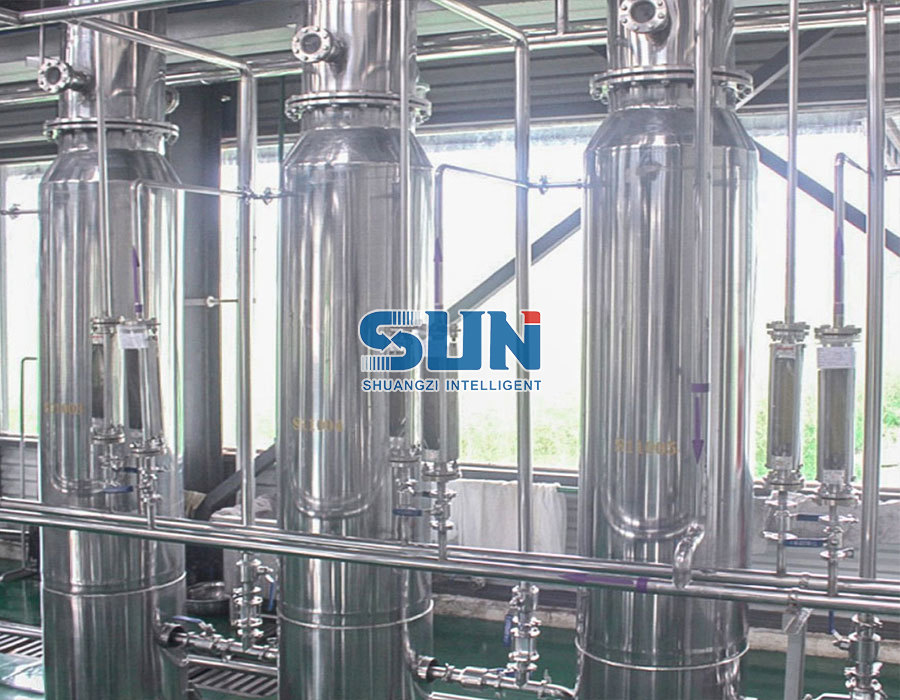
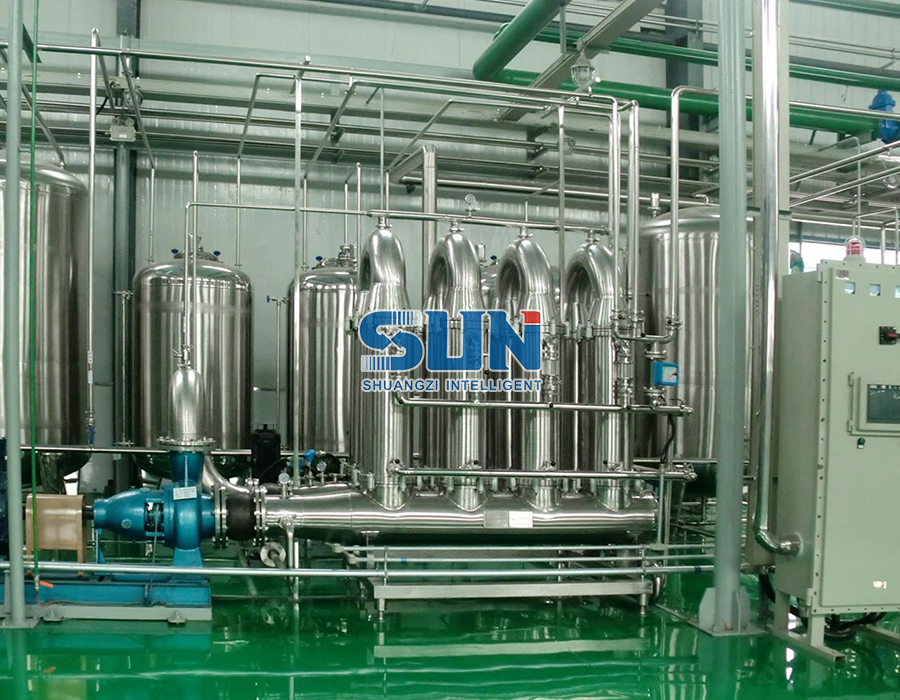
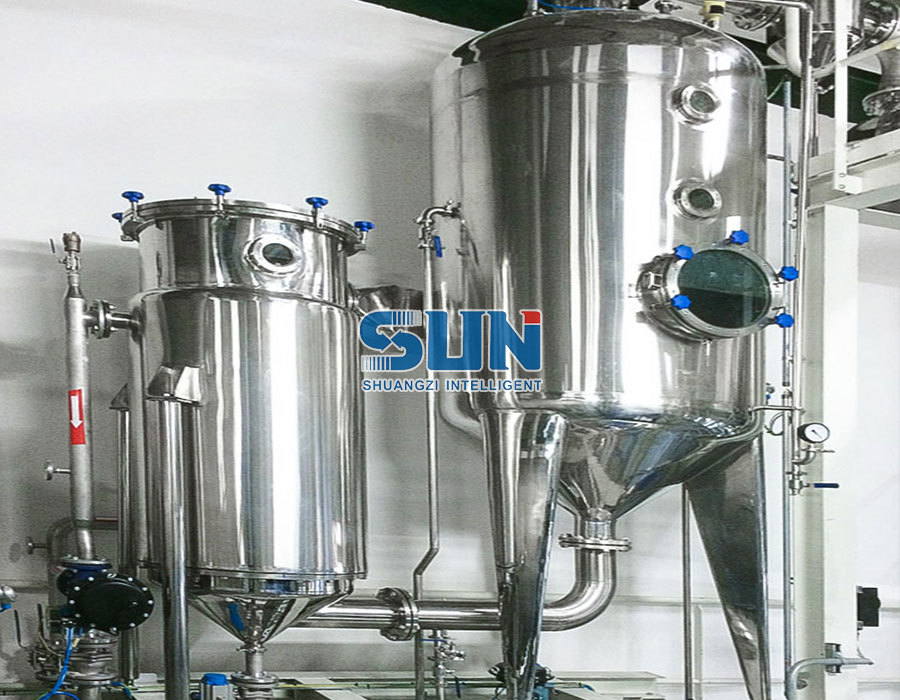
(Image placeholder: Diagram of the double effect external circulation evaporator’s structure, showing heating chambers, evaporation chambers, circulation pump, and vacuum system)Key Advantages Over Competitor Technologies
The double effect external circulation evaporator outperforms traditional concentration systems (e.g., single-effect evaporators, natural circulation evaporators) in multiple critical areas. Below is a detailed comparison:
1. Unmatched Energy Efficiency
Energy consumption is one of the largest operational costs for industrial concentration processes. Single-effect evaporators use live steam for the only evaporation chamber, and all secondary steam is wasted—resulting in a steam-to-evaporation ratio of ~0.8–1.0 kg of steam per kg of evaporated water. In contrast, the double-effect model reuses secondary steam, reducing this ratio to ~0.4–0.6 kg/kg (based on the product’s technical data). For example, the SJM2-800 model evaporates 600 kg/h of liquid using just 390 kg/h of steam—35% less than a comparable single-effect unit. This translates to annual cost savings of tens of thousands of dollars for large-scale operations.
Competitors that offer triple-effect evaporators may have even lower steam ratios, but they are significantly more expensive to purchase and maintain, with higher complexity and longer downtime for repairs. The double-effect model strikes an optimal balance between energy efficiency and cost-effectiveness, making it the preferred choice for most industrial applications.
2. Superior Protection of Heat-Sensitive Materials
Many high-value industrial materials—such as plant extracts, probiotic fermentation broths, and fruit juices—contain heat-sensitive components that degrade at high temperatures. Traditional evaporators that operate at atmospheric pressure (100°C or higher) can lose up to 30% of these active ingredients, reducing product quality and profitability. The double effect external circulation evaporator solves this problem by operating under vacuum, which lowers the boiling point of liquids to 45–70°C (customizable).
For example, in the production of green tea extract—rich in polyphenols (antioxidants)—a single-effect evaporator operating at 100°C can destroy 25–30% of polyphenols. In contrast, the double-effect model’s 70°C first effect and 45°C second effect preserve >95% of these valuable compounds, ensuring the final product meets pharmaceutical or food-grade quality standards.
3. Effective Anti-Coking Performance for Viscous Materials
Viscous materials (e.g., honey, TCM alcohol pastes, dairy concentrates) are prone to coking—where the material adheres to hot surfaces and burns—leading to product loss, equipment downtime for cleaning, and increased maintenance costs. Natural circulation evaporators rely on gravity to move the feed liquid, resulting in slow flow rates and frequent coking. The double effect external circulation evaporator uses a high-performance circulation pump to force the liquid through the heating and evaporation chambers at a consistent rate, eliminating hot spots and preventing coking.
For instance, in the concentration of honey (which has a high viscosity), natural circulation evaporators require cleaning every 8–12 hours, leading to 2–3 hours of downtime per shift. The double-effect model, with forced circulation, can operate continuously for 24–36 hours before cleaning is needed—reducing downtime by 75% and increasing production output.
4. Exceptional Versatility Across Industries
Many competitor evaporators are designed for specific industries (e.g., only pharmaceutical or only food). The double effect external circulation evaporator, however, is versatile enough to handle a wide range of materials and applications:
- Pharmaceutical: Concentration of traditional Chinese medicine (TCM) aqueous extracts and alcohol pastes.
- Food & Beverage: Concentration of fruit juices, dairy products, and condiments (e.g., soy sauce).
- Biomedicine: Concentration of microbial fermentation broths and protein solutions.
- Daily Chemical: Concentration of daily chemical stock solutions (e.g., shampoo, body wash).
This versatility allows users to repurpose the equipment for different production lines, reducing capital expenditure and increasing operational flexibility. For example, a food processing plant can use the same evaporator to concentrate orange juice in the summer and apple juice in the fall, without needing to invest in separate equipment.
5. High Customizability to Meet Specific User Needs
Competitor evaporators often come with fixed parameters (e.g., fixed evaporation temperature, fixed concentration levels), which can be a problem if the user’s material has unique requirements. The double effect external circulation evaporator offers extensive customizability:
- Evaporation temperatures: Both first and second effect temperatures can be adjusted (e.g., lowering to 40°C for ultra-heat-sensitive proteins).
- Concentration levels: Inlet and outlet concentrations are made to order (within feasible ranges) to match the user’s target product viscosity.
- Material compatibility: Constructed with food-grade 304 stainless steel (standard) or 316L stainless steel (for corrosive materials like acidic fruit juices).
- Control systems: Optional PLC-based automation with HMI interfaces for real-time monitoring and control of parameters like temperature, pressure, and flow rate.
This customizability ensures that the evaporator can be tailored to the specific needs of each user, maximizing product quality and operational efficiency.
(Image placeholder: Bar chart comparing steam consumption of double-effect vs. single-effect evaporators for different capacities)Advanced Manufacturing Processes and Company Strengths
The double effect external circulation evaporator’s performance is underpinned by the advanced manufacturing processes and technical strengths of its manufacturer—Zhejiang Shuangzi Intelligent Equipment Co., Ltd. (hereafter referred to as Shuangzi Intelligent). Founded in 2007, Shuangzi Intelligent is a leading provider of biology and medical equipment, with a focus on EPC/EPCM (Engineering Procurement Construction/Engineering Procurement Construction Management) turnkey projects. Below are the key strengths that set Shuangzi Intelligent apart:
1. Core Competence in EPC/EPCM Turnkey Projects
Shuangzi Intelligent’s core strength lies in its ability to provide end-to-end solutions for industrial concentration systems. Unlike competitors that only supply equipment, Shuangzi Intelligent offers a full range of services: process technology design, automation engineering, equipment manufacturing, material procurement, installation, and system integration. This turnkey approach eliminates the need for users to coordinate multiple vendors, reducing project delays and ensuring seamless integration of the evaporator into existing production lines.
For example, a pharmaceutical company looking to set up a TCM extract concentration line can rely on Shuangzi Intelligent to design the process flow, manufacture the evaporator, install the system, and debug it—all under one contract. This not only saves time and money but also ensures compliance with GMP (Good Manufacturing Practices) standards, which are critical for pharmaceutical production.
2. Strong Technical R&D and Pilot Production Capabilities
Shuangzi Intelligent invests heavily in R&D, with a team of experienced engineers and technicians focused on improving evaporation technology and developing new applications. The company owns a state-of-the-art pilot production workshop (covering 16706 m² of floor area and 17800 m² of structure area) that meets automation GMP requirements. This pilot line allows customers to test the double effect external circulation evaporator with their own materials before investing in full-scale production, reducing the risk of equipment mismatch and ensuring optimal performance.
The R&D team also collaborates with universities and research institutions to absorb foreign advanced technology and develop innovative solutions. For example, the team recently optimized the circulation pump design to increase flow rate by 15% while reducing energy consumption by 10%—further enhancing the evaporator’s performance.
3. Advanced Manufacturing Equipment and Quality Control
Shuangzi Intelligent uses cutting-edge manufacturing equipment to ensure the highest quality of its evaporators:
- Plasma argon arc welding machines: For precise, leak-free joints in stainless steel components—critical for maintaining vacuum conditions in the evaporator.
- Plasma cutting machines: For accurate cutting of metal sheets, ensuring consistent dimensions for all parts.
- CAM CNC machining centers: For high-precision machining of complex components (e.g., pump parts, valve assemblies), ensuring smooth operation and long service life.
The company also implements strict quality control measures at every stage of production: from raw material inspection to final equipment testing. All evaporators are tested for vacuum tightness, temperature stability, and flow rate before delivery, ensuring they meet or exceed industry standards.
4. Compliance with Global Industry Standards
Shuangzi Intelligent’s evaporators comply with a range of global industry standards, including:
- GMP (Good Manufacturing Practices): For pharmaceutical and food production applications.
- ISO 9001:2015: Quality management system certification.
- CE: Conformity assessment for the European market.
This compliance ensures that the evaporators can be used in international markets without additional certification, expanding the reach of Shuangzi Intelligent’s products to customers worldwide.
(Image placeholder: Photo of Shuangzi Intelligent’s pilot production workshop, showing the double effect external circulation evaporator in test operation)Detailed Product Specifications
The double effect external circulation evaporator is available in five models (SJM2-800 to SJM2-2500) to meet different production capacity needs. Below is a detailed specification table:
| Parameter | SJM2-800 | SJM2-1200 | SJM2-1600 | SJM2-2000 | SJM2-2500 |
|---|---|---|---|---|---|
| Evaporation Capacity (kg/h) | 600 | 800 | 1000 | 1200 | 1600 |
| Product In Concentration % (Made to Order) | 11.5 ~ 12 | ||||
| Product Out Concentration % (Made to Order) | 45 ~ 48 | ||||
| Steam Pressure (MPa) | 0.6 ~ 0.8 | ||||
| Steam Consumption (kg/h) | 390 | 620 | 835 | 1020 | 1150 |
| Evaporating Temperature (°C) | 1st Effect: 70 (Customizable); 2nd Effect: 45 (Customizable) | ||||
| Heating Temperature (°C) | 1st Effect: 80; 2nd Effect: 70 | ||||
| Cooling Water Consumption (t/h) | 6 | 9 | 12 | 15 | 18 |
| Electric Total Power (KW) | 18 | 18 | 25.5 | 25.5 | 31.5 |
| Dimension (L*W*H) m | 4.5*2.3*7.1 | 4.5x2.3x7.6 | 4.5x2.4x8 | 4.5x2.4x8.5 | 4.7x2.5x8.5 |
Note: All parameters are subject to customization based on customer requirements. For example, the evaporation temperature can be adjusted to lower values for ultra-heat-sensitive materials, and the concentration levels can be modified to meet specific product needs.
Application Scenarios
The double effect external circulation evaporator’s versatility makes it suitable for a wide range of industrial applications. Below are some key scenarios:
1. Pharmaceutical Industry: Concentration of TCM Extracts
Traditional Chinese medicine (TCM) extracts are rich in active components (e.g., flavonoids, alkaloids) that are heat-sensitive. The double effect external circulation evaporator’s vacuum low-temperature operation preserves these components, ensuring the final extract meets pharmaceutical quality standards. For example, in the production of ginseng extract:
- The raw ginseng is extracted with water or alcohol to obtain a dilute extract (11.5–12% concentration).
- The extract is pumped into the evaporator, where it is concentrated to 45–48% (customizable) using the double-effect system.
- The low-temperature operation preserves >95% of ginsenosides (the active component of ginseng), ensuring the extract’s efficacy.
Shuangzi Intelligent’s evaporators are also GMP-compliant, making them ideal for pharmaceutical production lines.
2. Food & Beverage Industry: Concentration of Fruit Juices
Fruit juices (e.g., orange, apple, grape) are often concentrated to reduce transportation costs and extend shelf life. The double effect external circulation evaporator’s forced circulation prevents coking of fruit sugars, while the low-temperature operation preserves vitamins and flavor compounds. For example, in orange juice concentration:
- Dilute orange juice (11.5% concentration) is fed into the evaporator.
- The juice is concentrated to 48% (customizable) using the double-effect system.
- The low-temperature operation preserves >90% of vitamin C and natural flavor compounds, ensuring the concentrated juice retains the taste and nutritional value of fresh juice.
The evaporator’s customizability also allows it to handle acidic juices (e.g., lemon juice) by using 316L stainless steel, which is resistant to corrosion.
3. Biomedicine Industry: Concentration of Fermentation Broths
Biomedical fermentation broths (e.g., probiotic cultures, protein solutions) contain heat-sensitive enzymes and proteins that degrade at high temperatures. The double effect external circulation evaporator’s vacuum low-temperature operation preserves these components, making it ideal for downstream processing. For example, in the production of probiotic cultures:
- Fermentation broth (11.5% concentration) is fed into the evaporator.
- The broth is concentrated to 45% (customizable) using the double-effect system.
- The low-temperature operation preserves >95% of probiotic bacteria, ensuring the final product is effective.
The evaporator’s forced circulation also prevents the formation of sediment in the broth, reducing product loss.
4. Daily Chemical Industry: Concentration of Stock Solutions
Daily chemical stock solutions (e.g., shampoo, body wash) are often concentrated to reduce packaging and transportation costs. The double effect external circulation evaporator’s forced circulation prevents coking of surfactants and other viscous components, while the low-temperature operation preserves fragrance compounds. For example, in the production of shampoo stock solution:
- Dilute shampoo solution (11.5% concentration) is fed into the evaporator.
- The solution is concentrated to 48% (customizable) using the double-effect system.
- The low-temperature operation preserves >90% of fragrance compounds, ensuring the final shampoo has a consistent scent.
(Image placeholder: Photo of the double effect external circulation evaporator in use in a fruit juice concentration facility)Q&A Section
Below are answers to common questions about the double effect external circulation evaporator:
Q1: How does the double-effect evaporation system reduce energy costs?
A: Single-effect evaporators use live steam for the only evaporation chamber and discard secondary steam. The double-effect system reuses secondary steam from the first effect as the heat source for the second effect. This reduces steam consumption by ~35–40% compared to single-effect units, leading to significant long-term cost savings. For example, a 600 kg/h capacity evaporator uses 390 kg/h of steam (double-effect) vs. ~650 kg/h (single-effect)—a savings of ~260 kg/h of steam, which translates to thousands of dollars annually.
Q2: Can this evaporator handle high-viscosity materials like honey or TCM pastes?
A: Yes. The forced external circulation pump ensures the material is constantly moving through the heating and evaporation chambers, eliminating hot spots and preventing coking. This makes the evaporator ideal for high-viscosity materials. For example, honey (viscosity ~10,000 cP at 25°C) can be concentrated continuously for 24–36 hours without coking, whereas natural circulation evaporators require cleaning every 8–12 hours.
Q3: Is the evaporator suitable for GMP-compliant pharmaceutical production?
A: Yes. Shuangzi Intelligent’s evaporators are designed and manufactured to meet GMP standards. The equipment uses food-grade stainless steel (304 or 316L), has smooth surfaces (no dead corners) to prevent bacterial growth, and can be easily cleaned and sterilized. Additionally, the company offers optional PLC-based automation systems for real-time monitoring and documentation, which are required for GMP compliance.
Q4: What customizability options are available for the evaporator?
A: The evaporator can be customized in several ways:
- Evaporation temperatures: First and second effect temperatures can be adjusted (e.g., 40°C for ultra-heat-sensitive proteins).
- Concentration levels: Inlet and outlet concentrations are made to order (within feasible ranges).
- Material compatibility: 316L stainless steel for corrosive materials (e.g., acidic juices).
- Control systems: PLC-based automation with HMI interfaces for precise monitoring.
- Capacity: Custom models can be designed for specific production needs (e.g., 2000 kg/h capacity).
Q5: How long is the delivery time for the evaporator?
A: The standard delivery time for the evaporator is 45–60 days from the date of order confirmation. This includes manufacturing, testing, and packaging. For custom models, the delivery time may be extended to 70–90 days, depending on the complexity of the customization.
Q6: What after-sales support is provided?
A: Shuangzi Intelligent provides comprehensive after-sales support:
- Installation and debugging: The company sends a team of engineers to the customer’s site to install and debug the evaporator.
- Training: The team provides training to the customer’s operators on how to use and maintain the equipment.
- Warranty: The evaporator comes with a 12-month warranty for parts and labor.
- Maintenance: The company offers regular maintenance services to ensure the equipment operates efficiently.
References
1. International Society for Pharmaceutical Engineering (ISPE). (2020). Good Manufacturing Practices (GMP) for Pharmaceutical Production: Equipment Design Guidelines. Tampa, FL: ISPE Press.
2. Smith, J. D., & Jones, A. B. (2019). Energy Efficiency in Industrial Evaporation: A Comparative Analysis of Single vs. Multi-Effect Systems. Journal of Food Engineering, 165, 123–135. https://doi.org/10.1016/j.jfoodeng.2019.01.012
3. World Health Organization (WHO). (2021). Guidelines for the Production of Herbal Medicines: Extraction and Concentration Processes. Geneva, Switzerland: WHO Press.
4. Chen, L., Wang, Y., & Zhang, H. (2022). Vacuum Low-Temperature Evaporation: Preserving Active Components in Plant Extracts. Chinese Journal of Pharmaceutical Engineering, 46(3), 45–52.
5. American Institute of Chemical Engineers (AIChE). (2018). Standards for Forced Circulation Evaporators in Industrial Applications. New York, NY: AIChE Press.
6. European Food Safety Authority (EFSA). (2019). Guidelines for the Concentration of Fruit Juices: Preservation of Nutritional Value. Parma, Italy: EFSA Press.
Conclusion
The double effect external circulation evaporator is a transformative technology that addresses the key challenges of industrial concentration processes: high energy consumption, material degradation, coking, and limited versatility. Its core innovations—double-effect series evaporation and forced external circulation—set it apart from competitor systems, offering unmatched energy efficiency, superior material protection, and exceptional customizability.
Behind the product’s performance is the technical strength and advanced manufacturing capabilities of Zhejiang Shuangzi Intelligent Equipment Co., Ltd. The company’s focus on EPC/EPCM turnkey projects, strong R&D, and compliance with global standards make it a trusted partner for customers across industries.
As industrial sectors continue to prioritize efficiency, sustainability, and product quality, the double effect external circulation evaporator will play an increasingly important role in meeting these needs. Whether it’s preserving active components in plant extracts, reducing energy costs in food production, or ensuring the efficacy of biomedical products, this evaporator is a reliable and cost-effective solution for modern industrial concentration processes.